Financial task
- Using the Financial task
- Understanding the financial projection
- Editing and creating tariffs
- Payment options
- Finance provider integrations
Using the Financial task
Completing the Easy PV Financial task is an important part of designing and selling a PV system. The task has two main areas of focus:
- Create an accurate quotation to give to the customer. Fully cost the materials and services, set the relevant tax, apply any grants or discounts and configure how you want the quote to be presented.
- Generate estimated financial projections for the installed system over time. Include loans, running costs and other custom saving, set up payment schedules and configure tariffs to estimate when the system will break even.
Getting started with the Financial task
You can access the Financial task via the 'Tasks' drop-down menu or from the task list to the left on the project overview page.
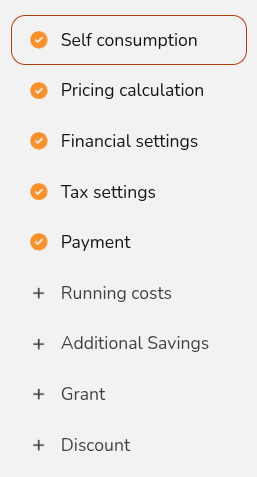
When the Financial task first opens, you'll be shown a popup that lets you configure the settings you want to use for the quote and projections. It will open on 'Self-consumption' and then you can use the right hand navigation to choose the settings you want to edit:
Tip: If you have set defaults via your account preferences, these will be automatically applied here.
If you'd like to change these values at a later stage, click Financial inputs in the top right or edit specific options directly from the right-hand sidebar.
Financial task inputs
Expand each section below for more details on each setting.
Self consumption
The proportion of electricity generated from a solar array that is used in a property can significantly affect financial returns. Easy PV has multiple methods you can use to calculate self-consumption and grid independence which you can select from.
In this section, you are selecting the self-consumption method for the project and choosing the tariffs. Each self-consumption methods has associated tariffs. Beside where the tariff is selected, you can also set the tariff inflation indexing.
These are the available methods to choose from:
- easy-pv.co.ukMCS: This can only be used with flat tariffs, can be used for projects with consumption between 1500-6000kWh, generation below 6000kWh and usable batter capacity below 15.1kWh
- Easy PV: This can be used for a project of any size and can be used with variable tariffs. This is calculated in the Consumption task
- Custom percentage: Input a self-consumption fraction directly. This will not model the impacts of a battery and is just calculated based on the total estimated annual generation
Warning: When using a custom percentage the Battery Storage section in the Customer Proposal will not generate. If you would like this to generate, select the MCS or Easy PV self-consumption.
Learn more:
Pricing calculation
Here you can select which pricing calculation to use, with the option of selecting between the following:
- Manual pricing: set a default markup on goods and input service costs on each project
- Automatic pricing: set a default markup on goods and automatically configure service costs for each project. Service costs will be calculated according to rules that you set
Learn more: How to set up your automatic pricing calculator
Financial settings
See how these settings impact the financial projection. You can set default values for this section in your account or pro financial settings or adjust them on a project by project basis.
-
Projection term: the number of years you wish to make financial projections. This should be approximately the expected lifespan of the equipment
- Inflation rate: this is the inflation rate for your financial projection
Note: This base inflation rate will be applied to all costs and savings, you can set a different inflation rate for tariffs in the
Self-consumptiontab. -
Panel degradation rate: panels gradually reduce in output as they degrade over time. Set the rate at which the output of the panels decreases each year
-
Discount rate: a discount rate is a means of determining the current value of something (like income or savings from a PV system) that you'll receive in the future. Set this to 0 if you would like no mention of discount rate in the proposal
Learn more: Understanding the Financial projection.
Tax settings
Configure the following:
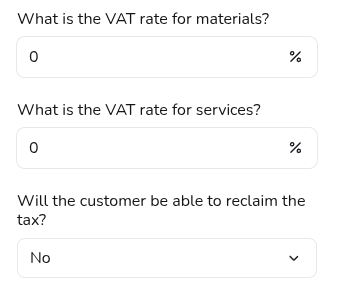
- VAT rate for materials: this will apply to all costs included in the goods section.
- VAT rate for services: this will apply to all costs included in the services section.
- Whether the customer can reclaim VAT: selecting that the tax can be reclaimed will mean VAT is excluded from the loan total (if applicable) and the cost on the front of the proposal, but not the cost used in the financial projection.
Learn more: Set up default values for this section in financial settings.
Payment
In this section you can configure how the customer will pay for the system, with the option to either pay in full or with finance. Any discounts or grants are configured in later sections but will be automatically factored in.
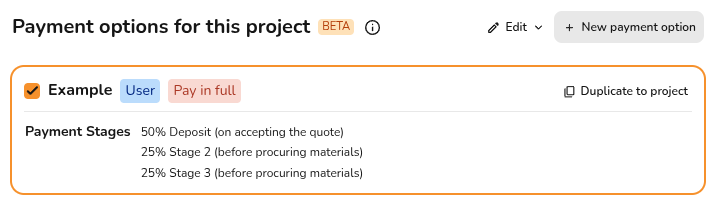
- Select from your preset payment options for this project or create new ones. You can set default values for this section in your financial settings.
- If you'd like to amend an existing one for this project, you can just duplicate to project and edit any details or navigate to your financial settings by click
Editoption at the top to edit the default option.
Learn more: Setting up payment options.
Note: A pay in full option is required on all projects, even if the customer intends to pay with finance.
+ Running costs
Add rows for costs you expect to be incurred in the future. You can choose whether costs are applied on an annual basis (for example a maintenance contract) or as one-off costs (for example an inverter replacement).

Learn more: Default running costs can be set up in your financial preferences.
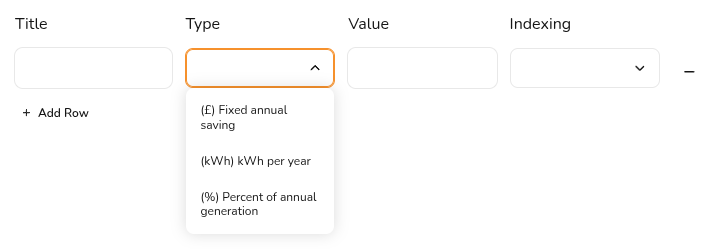
+ Additional savings
Add rows for additional savings, such as from immersion diversion systems or from night charging from batteries.
Set the name for the saving, what the saving is (this can be in terms of £, kWh per year or a % of annual generation) and how it should scale with inflation.
Learn more: Default savings can be set up in your financial preferences.
+ Grant
If the project is eligible for a grant that will pay for some or all of the cost of the system, you can add it here.
Set the description, the value and whether this is claimed before or after the installation.

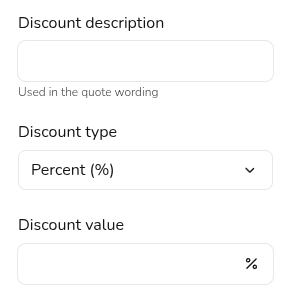
+ Discount
If you want to apply a discount to your quote to reduce the cost for your customer, you can do so here. Input a description and choose the type of discount you want to apply. This can be a fixed discount or a percentage of the total cost.
When you have finished updating the settings, click Save & Exit. This will then allow you to view and modify the quotation and view the projection.
Learn more: Set up Automatic pricing rules and configure Financial defaults to speed up this part of the task.
Navigating the Financial task
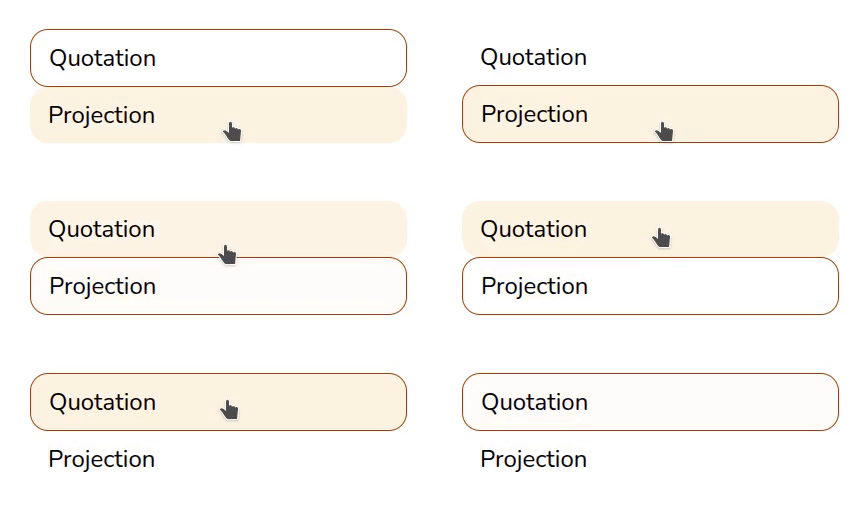
The right hand sidebar contains options to switch between the quotation and the projection view:
You also have the following actions in the top right corner:

Click to edit the financial settings used in the projection Open help page
Go directly to this help page if you're ever having trouble Refresh pricing
Recalculate cost of goods, services or both reflect any changes you've made to the project via other tasks Export quotation as a CSV
Customise the CSV file that will be downloaded. Line items will be based on the quotation in Financial Task Auto-pricing settings
Adjust settings used in automatic pricing calculator directly from the Financial task Go to user preferences
Edit defaults used in Financial task


Quotation view
In the quotations view, you can view and edit the quotation under the following headings:
- Goods: Here you can see the full kit list and + add or - delete any rows. To the right is the option to display or hide the markup and edit the quote view
- Services: If using automatic pricing, you will see your service totals and can then make any adjustment. If not using automatic pricing, you can add your services costs here
- Total: Below, you will be able to see the total cost of the system for the customer, including any grants or discounts applied via the financial settings you've applied to the project
Warning: Changes made to the components in the project will not automatically refresh here. Click the refresh icon in the top right to recalculate any costs.
Projection view
At the top of this page you will see the annual generation, payback period, internal rate of return and net present value. A positive net present value is a good indication that the project is financially worthwhile. You will also see the following details about the projection:
- Income and savings: This graph shows the projected income from the system over the project lifetime in payments for generated and exported electricity, along with electricity savings
- Running costs and loan: If a running cost is included or finance option is selected, then these will show up in these graphs
- Bottom line: This graph will then indicate the cumulative costs and benefits of the system. When these two lines intersect is when the system benefits become equal to the cumulative costs, after this time the customer is projected to gain from their solar system
- Payment options: On the right-hand side you can view and the payment options on this project. Switch between them to see the impact they have on the financials for this project
Learn more: For more details on the financial projection and how you can improve it, see Understanding the Financial Projection.
Still Need Help?
Contact Support: If you've got further questions, get in touch with our support team at help@easy-pv.co.uk (UK) or help@easy-pv.ie (IE). If you are experiencing a bug, to help us look into your issue faster, please include the email address of your account, the name of the project and screenshots of any unexpected behaviour
Understanding the financial projection
The financial projection is determined by the system cost, system output and your financial settings. Correctly configuring these settings is crucial to getting an accurate financial projection.
Where do I find the financial projection?
The financial projection is found in the financial task. Navigate between the quotation and the projection page on the left. Select between payment options to see the impact on the financial projection.

Income and savings
This section shows the income and savings across the projection period. Income is made up of export payments and savings are made up of electricity savings and any additional savings configured.
Electricity savings
This is how much we project the customer will be able to save now they will not be spending this on their electricity bill and will instead be using energy from the panels or battery. This is calculated using the annual generation and import tariff (using the customers old tariff if they are switching tariffs).
Determined by: import tariff, battery management, degradation rate, inflation rate
Note: If you have forced battery charging and discharging configured, you may find the electricity savings are negative. Provided the total income and savings is still greater than how much they were previously spending on electricity, this is not a problem. If your electricity savings are negative, we will just show the total benefit in this section.
Export benefits
This is how much we project that the customer will be able to earn from exporting electricity to the grid.
Determined by: export tariff, battery management, degradation rate, inflation rate
Additional savings
This models any additional savings that aren't factored into the MCS or Easy PV model.
Determined by: additional savings in financial task, inflation rate
Loan and running costs
The loan and running cost graphs will show any costs that they will incur in the first year and beyond. These will be factored into the total cost of the system across the period and used in the payback calculation.
If you have set up a finance option, you can select this from the right side bar to see the impact this has on the projection.
Bottom line
This section gives an overall indication of the benefits of the system and whether it is a worthwhile investment for the customer. Below are some key definitions.
Discount rate
Tip: Set the discount rate to zero if you would not like it used in the proposal.
A discount rate is a means of determining the current value of something (like income or savings from a PV system) that you'll receive in the future. This is set in your project financial settings.
How is this discount rate used?
Discount rate is used to reflect that money earned in the future is less valuable than money earned now. In Easy PV, we use the discount rate to calculate discounted benefits by scaling each year’s benefits down by half the discount rate to reflect the average rate across the year.
Net Present Value
This is the difference between cumulative benefits and the cumulative costs of the system across the projection period, both factoring in discount rate. When this is positive, it indicates the expected benefits (discounted to present value) exceed the expected costs (also discounted to present value).
Internal Rate of Return
This is the discount rate that, when used to calculate NPV, makes NPV 0.
How do we calculate the IRR and NPV?
The IRR is calculated for the final year of the projection period. However, this cannot be calculated exactly. For year 1, rates between 0% and 40% are tested and the value that gets the NPV closest to 0 is chosen. This year 1 value is then used to calculate the IRR of the next year until we reach the final year of the projection period.
Then to calculate the NPV we do the following:
Present year's NPV = previous year's NPV + (benefits - costs) * IRR factor
where present year refers to the current year being calculated and
IRR factor = 1/((1+IRR)^years)
To calculate the final IRR, we use the NPV calculated for the final year of the projection period, again finding the IRR that makes the NPV closest to 0.
Payback
This is how long it takes for the benefits of the system (savings on bills, earnings from exports) to outweigh the costs (initial cost, loan payments, maintenance costs). In each case, these are discounted to today's value and factor in the inflation rate and degradation rate.
The graph shows the year by year costs (red) and benefits (green) of the system, including any income, savings, running costs and finance payments. When plotted against each other, the point where cumulative benefits equal cumulative costs gives the payback period.
Payback period coming out longer than you'd expect? Read here for things you can do to help with that.
Still Need Help?
Contact Support: If you've got further questions, get in touch with our support team at help@easy-pv.co.uk (UK) or help@easy-pv.ie (IE).
Editing and creating tariffs
This guide covers how you can manage and create tariffs in Easy PV. Setting tariffs is an essential part of ensuring the financial benefits can be calculated as accurately as possible for your customer.
Tariffs can be created, viewed and edited in the Consumption task or the Financial task. You can also set up user-level default tariffs in your account financial settings or if you are a member of a Pro team, this will be set by a Pro team admin in Pro account financial settings.
Overview
Creating a tariff
Tariffs can be set up in individual projects from the Financial or Consumption task or in User/Team financial preferences.
Flat or single-rate tariffs
Flat tariffs can be used with any self-consumption calculation.
Step 1. Set the name of the tariff
This name will appear in the quote wording.
Step 2. Set the scope of the tariff
Set when you want to be able to use this tariff:
- User-level: For any of my projects
- Project-level: Only for this project
- Team-level: Available to my team
Note: Once the scope of the tariff has been set, this cannot be edited.
What is the scope of the tariff for?

- These will only be viewable on the specific project it's created for
- A good option if you frequently change the tariffs on each project

- These can be used for any projects and set as a default in your financial settings
- A good option if you aren't sure what tariffs your customer is on and want to use standard values
- User-level tariffs will not be shared within shared projects

- If you are a member of a Pro Team, you will be able to create Team-level tariffs
- These will work much like the User-level tariffs but will show for all members of your team
Step 3. Input the price bands
Enter a value for the base rate and click Save.
Variable or multi-rate tariffs
Variable tariffs can only be used with with the Easy PV self-consumption calculation. These can only be created from the Consumption task or financial preferences.
Steps 1 and 2
Follow steps 1-2 as above.
Step 3. Input the price bands
The first band you enter will be used as the base rate - any time period that doesn't have a price band applied will be priced at this rate.
Click + Add row and enter each different tariff rate. The names of each price band will be displayed on the proposal.
Step 4. Add tariff periods
In the Tariff periods section click + Add tariff period.
Select a price band and enter the start and end time. For some tariffs different rates might apply at the weekend, you can select the days for which the tariff period applies. This feature can be used to configure tariff bands that are active only during certain periods of the day e.g. a cheaper overnight price band.
Using tariffs in a project
In Easy PV, certain tariffs can only be used with certain self-consumption calculations. The tariffs selected on a project are therefore associated with certain self-consumption methods. Variable or multi-rate tariffs can only be used with the Easy PV self-consumption calculation, whereas flat or single-rate tariffs can be used with any method.
Learn more: The differences between MCS and Easy PV self-consumption calculations.
View and edit tariffs
To view the tariffs you have selected on a project, navigate to the Financial task. Click Financial inputs in the top right and you will see which self-consumption method you have selected and the associated tariffs.
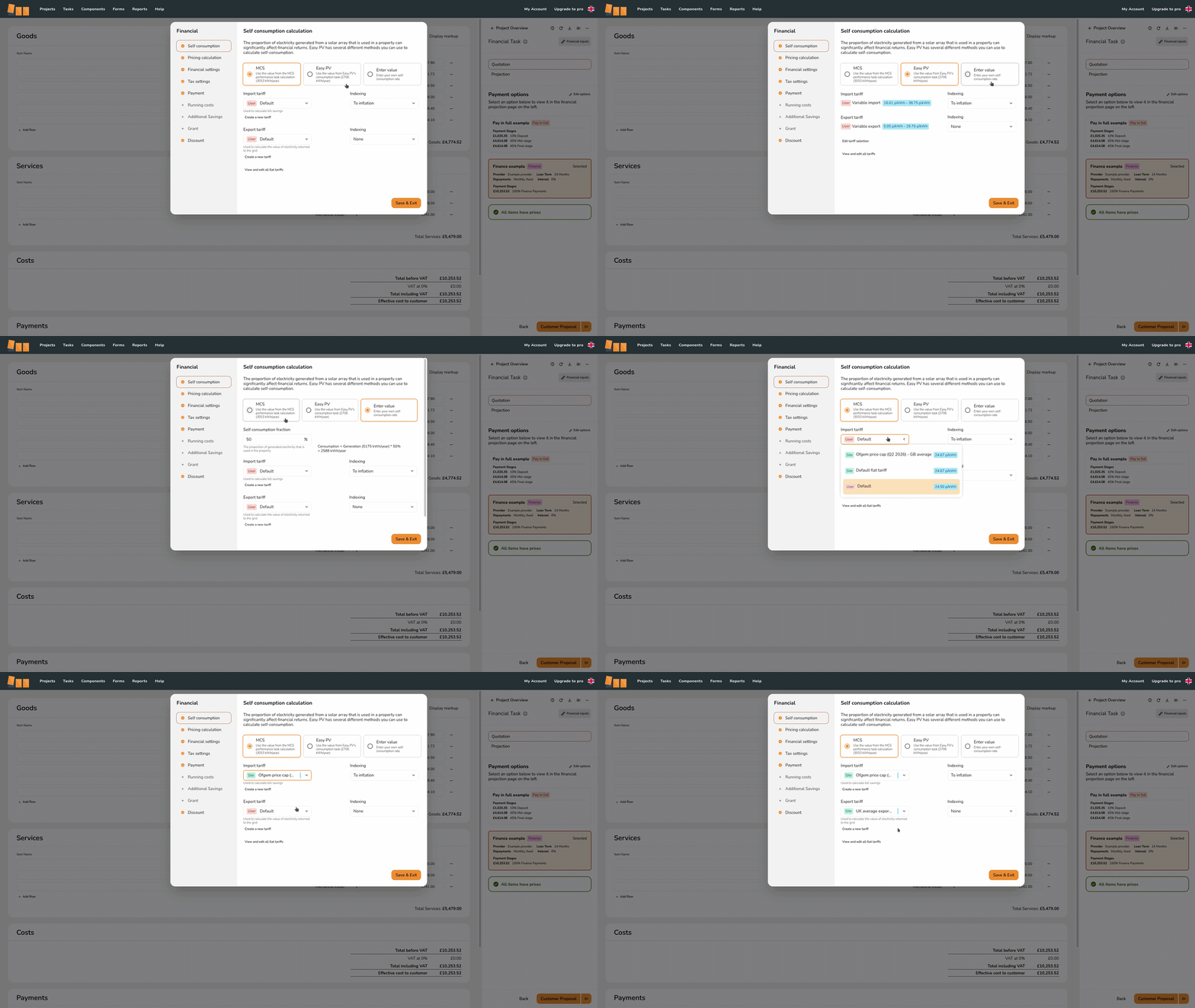
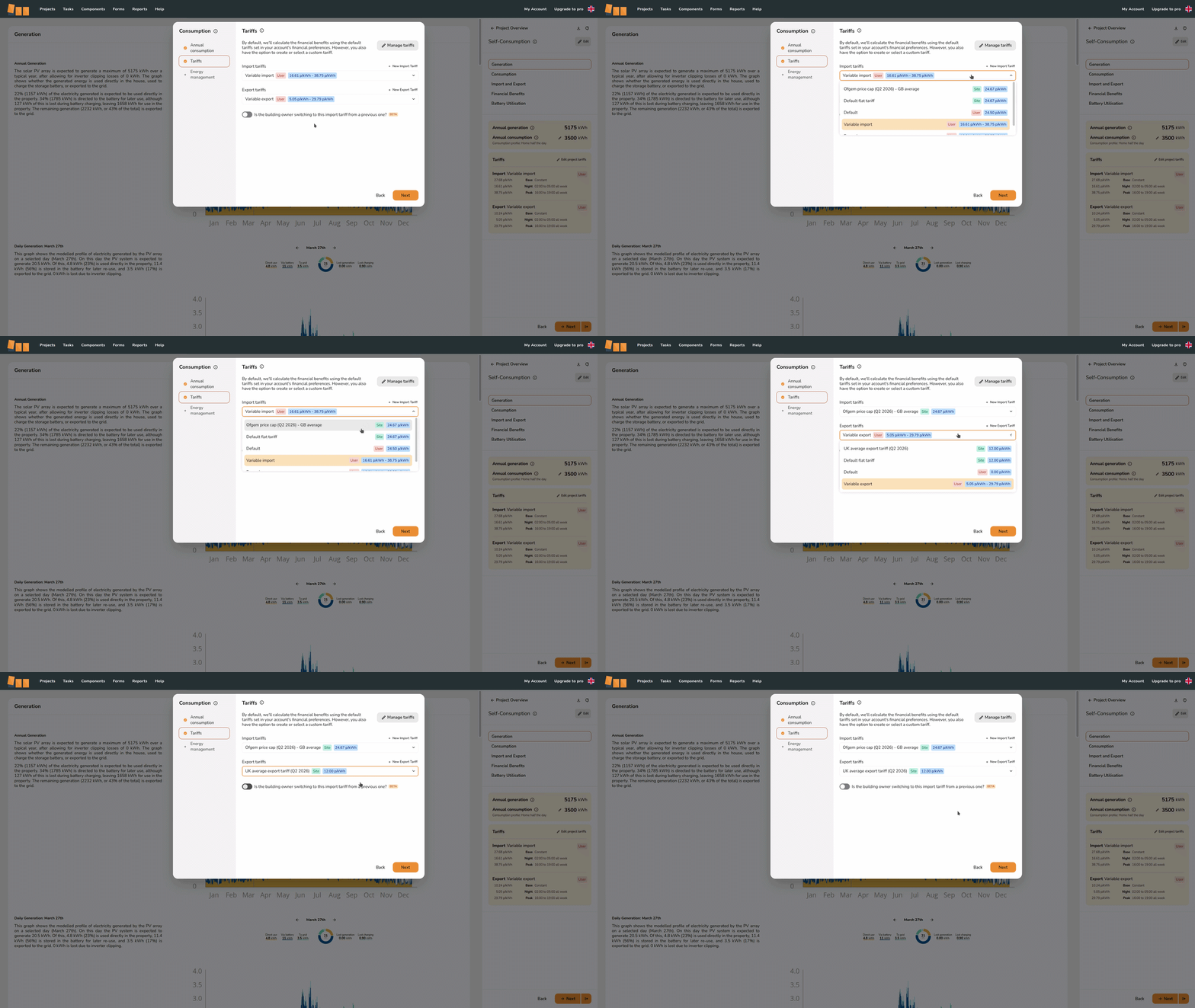
If you are using the MCS or Enter-value self-consumption calculation, you can view and edit the tariffs used on the project in the Financial task. If you are using the Easy PV calculation, you can only edit the tariff selection from the Consumption task. Navigate to the Consumption task and click Edit in the top right and select the Tariffs tab.
Inflation indexing
The rate at which tariffs change with inflation is important in calculating the savings to be made from solar and any ongoing electricity costs. Easy PV projects will have a base inflation rate (set in the Financial settings tab of the Financial task inputs).
In the Financial task inputs on the Self-consumption tab you can set the inflation indexing for the selected tariffs. Choose from:
- To inflation: Tariffs will increase each year with the same base inflation rate as the project
- Above inflation: Tariffs will increase each year at a specified percentage above the base inflation rate of the project
- Fixed: Tariffs will increase by a fixed percentage each year
- None: Tariffs will not increase and will remain fixed across the projection period
These can be set independently for import and export rates.
Read more: Importance of using the right financial settings.
Managing tariffs
You can view and edit your tariffs from within projects (in Financial task > Financial inputs > Self consumption or Consumption task > Edit inputs > Tariffs) or within your financial settings.
Click Manage tariffs from the Consumption task, View and edit all (flat) tariffs from the Financial task or View and Edit Team/User-level tariffs from financial settings. You will see the following options alongside the details of each tariff:
+ Add import tariff
Click this to create a new tariff- Click the ⋯ three dots to view the following options:
 Edit
Edit
Click the pencil to make any changes to existing tariffs. These changes will affect existing projects using this tariff Hide
Hide
This will remove the tariff from the drop down list of tariffs in new projects without affecting old projects using this tariff Delete
This will delete the tariff and cannot be undone. Existing projects using this tariff will switch to your default tariff



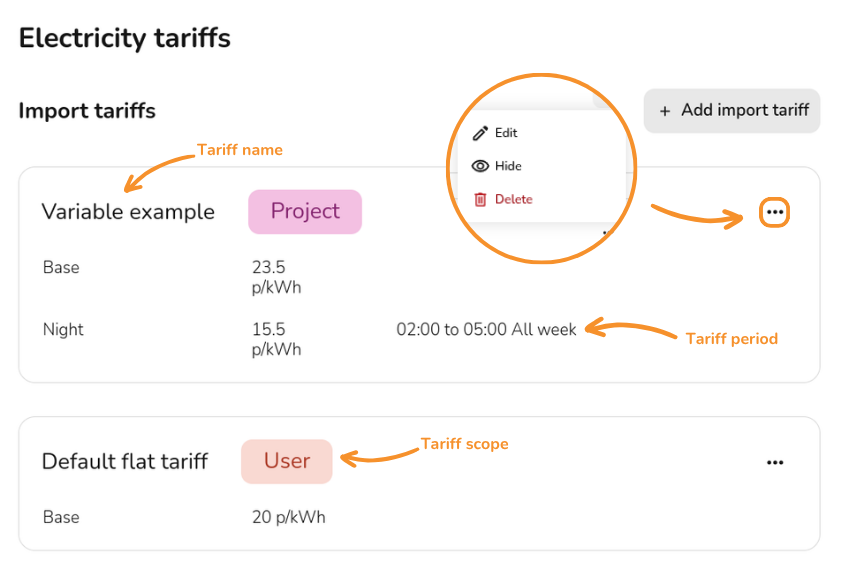
Warning: Editing or deleting existing tariffs will affect previous projects that use these tariffs. Hide any tariffs you want unavailable on new projects without affecting existing ones.
Still Need Help?
Contact Support: If you've got further questions, get in touch with our support team at help@easy-pv.co.uk (UK) or help@easy-pv.ie (IE). If you are experiencing a bug, to help us look into your issue faster, please include the email address of your account, the name of the project and screenshots of any unexpected behaviour.
Payment options
A payment option is a method by which the customer can pay for a project. Payment options can be created, viewed and edited in the the financial task. You can also set up payments in your account financial settings. If you are a member of a Pro team, this will be set by your team admin in the Pro account financial settings.
Managing payment options
Creating a new payment option
New payment options can be created within projects through the financial task on the Payment tab or by navigating to your financial settings. Just click + New payment option and follow the steps outlined below.
1. Overview
Name: Input the name you'd like to appear on the proposal for this payment option. 
Scope: The option will only appear if you're creating a payment option from within a project. Select whether you'd like this option to appear for just this project or to be available on future projects. If you are in a pro team, you will also see the option to make it available for you team. 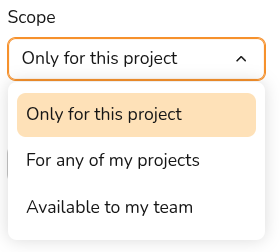
Payment type: Select between Pay in full or Finance depending on what payment option you need. For both options you can set up multiple payment stages and for finance options you can model paying off some or all of the cost of the system with a loan. This can be changed at any point. 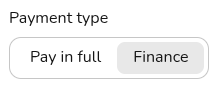
Default checkbox: This option will only appear if your scope is set to User or Team. If you check this box, this payment option will be selected on all future projects. 
2. Payment
In this section you can configure the payment stages for the quote. This is optional if you selected Finance as the payment type.
Payment format: set whether you'd like payments to be defined as percentages or as constant values. 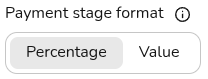
Payment stages: add rows to define additional payment stages, set the name of the stage to appear on the quote, the amount (% or £) and when the stage will be payable. If Finance was selected, the final (or only) stage will be from 'Finance Payments'. 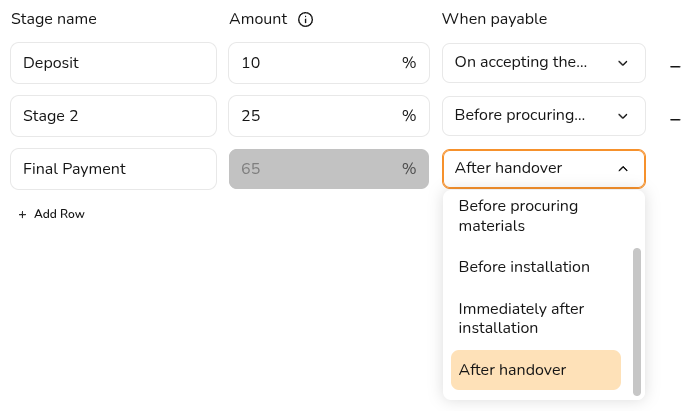
3. Finance
Here you can configure the details of the finance payments. This section will not appear if you've selected Pay in full.
Finance provider: This is the organisation or lender that provides finance or a lease for a project. Select from the drop down menu from your preset finance providers or select + New provider.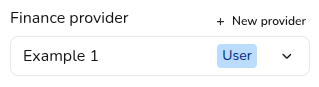
When creating a new provider you will need to input the name of the provider, the scope (if you're creating within a project) and an optional description.
Repayment: set the repayment term, the repayment frequency and the repayment type. For most domestic installations, the repayment type will be fixed. 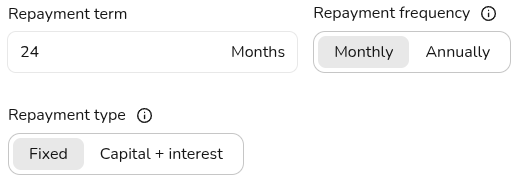
Interest: set the loan interest rate and whether you want the interest to compound monthly or annually. 
4. Disclaimer
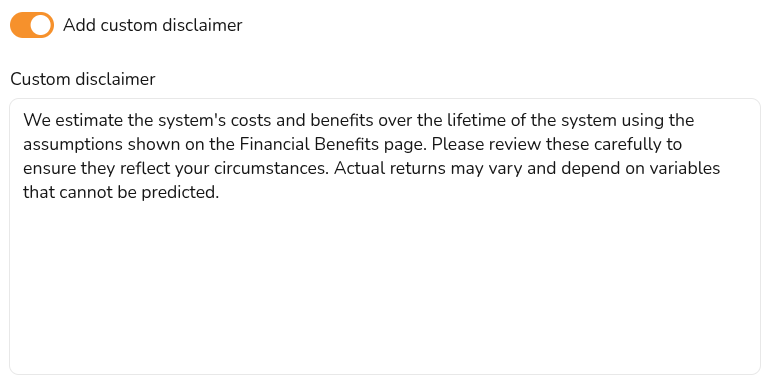
Set whether you'd like to include a custom disclaimer - this will appear next to the financial calculations for this payment option.
Editing existing payment options
If you would like to edit existing payment options, this can be done within a project or in your financial settings. All details listed above can be edited on your payment options except the scope. To change the scope of a payment option, duplicate the option within a project and set the new scope from the overview tab.
Financial settings
Open your user or team Financial settings and scroll down to Payment options and providers. Here you can see all your payment options and providers and create new ones.
On each payment option, you'll have the following options:
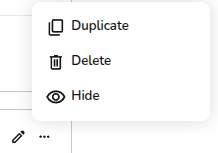
- Edit
Click the pencil to edit existing options. - Click the ⋯ three dots to view the following options:
 Duplicate
Copy and edit an existing payment option or provider if you need to make small changes to an existing option Delete
This will delete the payment option or provider and cannot be undone. Previous projects using these options will be unchanged- Hide
This will no longer show as a payment option or provider but will still show in this menu. It can be un-hidden at anytime from your financial settings


Within a project
In a project you can select the payment methods you'd like to make available to the customer. You can create a new payment method for your current project (or any future project by setting the scope to User or Team) by clicking + New Payment Option. Update your existing methods in your settings with the Edit option at the top.
Note: project level payment options can be edited, deleted and duplicated but user and team level options cannot be edited or deleted from within a project. Navigate to your financial settings to edit user or team level payment options or duplicate to make a project level copy.
Still Need Help?
Contact Support: If you've got further questions, get in touch with our support team at help@easy-pv.co.uk (UK) or help@easy-pv.ie (IE). If you are experiencing a bug, to help us look into your issue faster, please include the email address of your account, the name of the project and screenshots of any unexpected behaviour
Finance provider integrations
FinMatch finance option in Easy PV
Setting up with FinMatch in Easy PV
Step 1: Sign up for FinMatch
You can apply through Easy PV to FinMatch to offer finance through Easy PV. FinMatch offers access to finance plans from multiple lenders. FCA Assist helps installers get authorised quickly and efficiently.
FinMatch Finance Assistant enables your customers to click from an Easy PV quote and apply for finance instantly.
To get started:
- Standard users: Go to
My Account>Preferences>Financial. Scroll down to Providers and clickApply now. - Pro users: Go to
Pro Account Settings>Financial. Scroll down to Providers and clickApply now.
If you are in a Pro team, only team owners can apply via Pro account settings.
Step 2: Approval from FinMatch
Once approved, we will link your FinMatch account with your Easy PV account.
Step 3: Configure in Easy PV
In your financial settings, you can configure your FinMatch settings:
- Standard users:
My Account>Preferences>Financial. Scroll down to Providers. - Pro users:
Pro Account Settings>Financial. Scroll down to Providers.
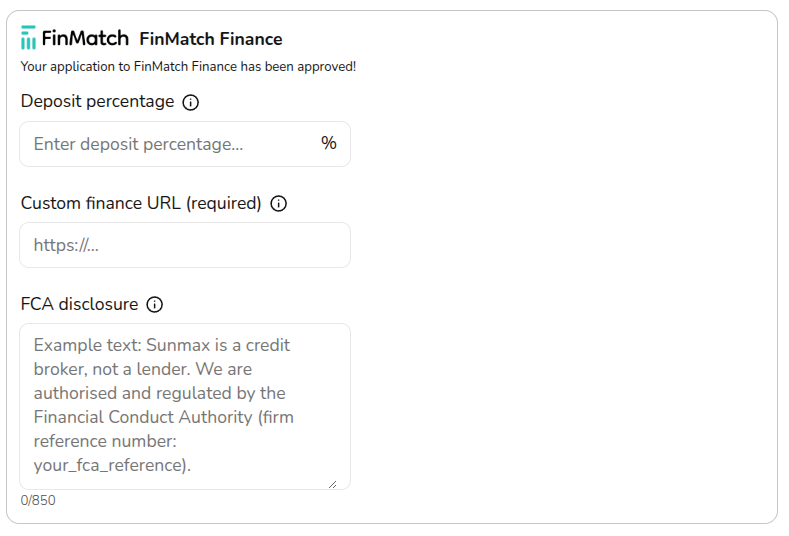
Deposit percentage
Enter the percentage of the total system cost that the customer must pay as a deposit. This amount will not be included in the financed total.
This amount can be edited on a per project basis.
Custom finance URL
Enter the full URL of the finance page on your website (for example: https://www.yoursite.co.uk/finance). This link will be shared with FinMatch.
A custom link to the FinMatch Finance Assistant will then be generated for each FinMatch finance option included in a customer proposal. Read more about this in Step 5.
FCA disclosure
Enter the customised text of your required FCA Disclosure which will be displayed on each finance option generated through FinMatch that is included in the customer proposal.
Example disclosure text
[Your Company Name] is a credit broker, not a lender. We are authorised and regulated by the Financial Conduct Authority (FCA) (firm reference number: XXXXXX). We do not provide financial advice but offer credit products from a carefully selected panel of lenders, all of whom are authorised and regulated by the FCA. We do not charge customers a fee or earn a commission for our credit broking services. Details of our regulated credit products are explained on our website. Credit is subject to age, status and affordability. Borrowing more than you can afford or paying late may affect your financial status and ability to obtain credit. You are not obliged to use the lender we suggest. You are free at any time to explore and secure financing independently, and it is possible that you may find a better offer elsewhere.
Note: there is an 850 character limit on this disclosure text.
Using FinMatch finance options in a project
Step 4: Enable FinMatch in a project
Navigate to Financial task > Financial inputs > Payment options. You will then see FinMatch as a finance option alongside any other payment options you have configured.
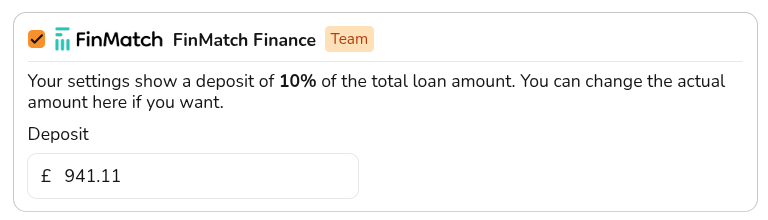
Tick the FinMatch Finance option and (optionally) edit the deposit amount. Some finance options will have a minimum deposit value so this may be overridden.
Click Save & Exit in the bottom right or navigate to the next section in the menu on the left.
On the Projection tab, you can navigate between the available finance options from FinMatch on the right-hand sidebar to see the payback for each option.
Step 5: Generate proposal
In the customer proposal, the Payment Options pages that detail finance options generated through FinMatch will include a “Learn More” link. When clicked, this link will direct the customer to a finance details page on your website. This link can be accessed from an e-signing link or from a saved PDF.
Want to know more?
Contact Support: If you've got further questions, get in touch with our support team at help@easy-pv.co.uk (UK) or help@easy-pv.ie (IE).