Financial task
- How is the payback period calculated?
- The payback period is too long, how can I fix this?
- Why are there two consumption figures to choose from in the financial task?
- How can I factor VAT into the cost?
- How do I factor in a standing charge?
- Why do some of the financial savings appear to be different on the Customer Proposal and Easy PV Project Report?
How is the payback period calculated?
The payback period is the time it takes for the benefits of the system to outweigh the costs.
Easy PV calculates how much is saved on the electricity bill and earned from exporting across the payback period, using the selected tariffs and factoring in any financial projection settings. It then similarly calculates any costs incurred across the payback period including the upfront cost, finance payments and any maintenance costs.
Take a look at our guide on using the financial task and understanding the financial projection for additional information.
The payback period is too long, how can I fix this?
There are a few things that can help with the payback period. The payback period is calculated by weighing up the cumulative benefits of the system against the cumulative costs. Therefore, to improve the payback period, you either need to reduce costs or increase the benefits,
In general, how to improve the payback period is very case dependent but below are some generic suggestions and key areas to check:
Further information on tariffs can be found in our tariffs guide.
Why are there two consumption figures to choose from in the financial task?
If you have completed both the MCS self-consumption calculation and the Easy PV consumption calculation in the project, both figures will appear as options when you open the Financial task in Easy PV.
The MCS method is calculated end of the Performance task for easy-pv.co.uk and the Easy PV method is calculated in the Consumption task. Both are acceptable methods for calculating the self-consumption, you are free to choose either calculation. You can read more about the differences here.
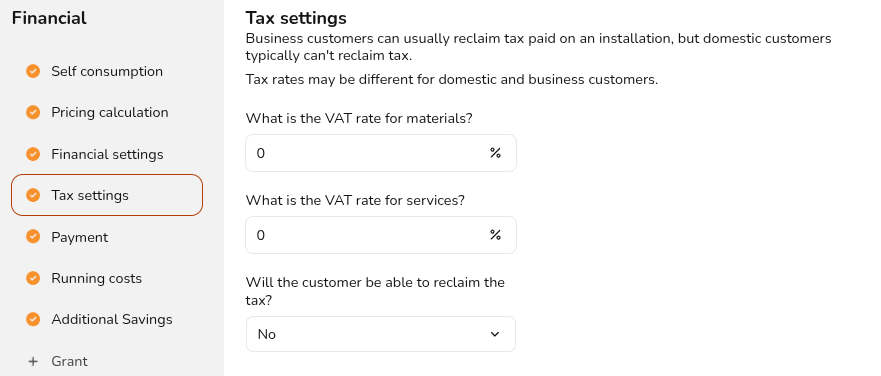
How can I factor VAT into the cost?
Yes, you can do so by following these steps:
- Navigate to the Financial task
- Click the pen in the top right corner
- Then under Tax settings you can set a rate for materials and services, and include whether the customer can claim this tax back

How do I factor in a standing charge?
Easy PV does consider standing charges in it's financial calculations so it is unfortunately not possible to factor in.
Why do some of the financial savings appear to be different on the Customer Proposal and Easy PV Project Report?
Easy PV uses two different methods of calculating financial savings.
1) We do a basic calculation to work out a headline year one/first year saving figure that can be used on proposal summaries, etc. This calculation doesn’t take into account inflation or degradation rate.
2) We calculate a financial forecast showing payback for a longer period (25 years by default). This takes into account inflation, degradation, and discount rates. In the first year, we apply half the % values for each of these rates rather than the full % value. If you're wondering why we use half the % values for the first year, please see below for an explanation.
Further information
When you pay for a PV install you do so in a lump sum on day 0. You then start getting savings and export income from it. But by the end of the first year, monetary values have risen by inflation. So if you were saving £100 / month for electricity on day 0, by the end of the year - day 365 - you are saving £104 / month if the inflation rate is 4%.
When working out the savings for year 1 therefore, we need to work out the average for the year. If savings were £100/month at the beginning, and £104/month at the end the average is £102/month. So for that first year, we use half the inflation value to work out the average savings.
For year two, we again need to use the average value of money over the course of the year. This will have increased by the value of inflation from the value that we used for year one. Basically we are comparing the value of money at 6 months to the value at 18 months. So £102 for year one becomes £106.08 (£102 * 1.04) if the inflation rate is 4%.
It's exactly the same with degradation. On day zero the panels are generating at 100%. By day 365 they have degraded slightly. With degradation of 1% a year we would expect them to be at 99% capacity. The expected average generation for the year is halfway between those two values, so we use 99.5% for year one rather than 99%.