News and updates
Easy PV is always improving to help installers deliver smarter, more efficient solar projects. This page highlights new feature releases and updates, along with blogs and articles designed to help you succeed.
- New in October 2026
- New in September 2026
- New in August 2026
- New in July 2026
- Smug: Smart battery optimisation
- The power of choice: Why flexible payment options are so important
- New in April 2026
- New in March 2026
- New in February 2026
- Speedy PV: turn curiosity into commitment
- New in January 2026
- Easy PV Pro: help your team work more efficiently
- The importance of using the right financial settings in Easy PV
- Understanding energy management options
- Why customer proposals matter in solar PV
- Maximizing ROI: The installer's role in system optimisation and customer education
- New in September 2025
- New in February 2025
- New in January 2025
- New in December 2024
- New in November 2024
- New in October 2024
- New in April 2025
- New in September 2024
- New in August 2024
- New in July 2024
- New in June 2024
New in October 2026
Updates
- The updated Roof Outline design mode, with automated roof detection, is now available on Easy PV Ireland.
- Updated the Renusol hanger bolt options for fibre cement and sheet metal roofs. Steel purlin roofs now use the 150mm hanger bolt only.
- Updated the Fastensol MCS012 data to their latest MCS certificate (MR 50735501).
- Improved how SolShare handles incompatible hybrid inverters and batteries.
- AC isolators, DC isolators and meters now link to their own help page from the component editor.
- Team management now shows the date each team was created.
Fixes
- Corrected Solfit parts lists to stop over-speccing on multi-roof installs.
- Fixed Solfit bottom flashing options not selecting.
- Fixed optimiser selection for SolarEdge inputs in the Inverter task.
- Fixed hybrid inverters not showing their charge rate and efficiency in the Inverter task.
- Fixed the “switching 2 strings in parallel” option disappearing after choosing a 2-pole DC isolator.
- Whole System Design now explains when a roof is missing an orientation, instead of showing an error.
- Customer details in the navigation bar now update straight away after editing project details from another window.
New in September 2026
Updates
-
We have released a Whole System Design tool for automated kit combinations and design recommendations.
- Released Online Proposals which allow you to send your customers an interactive web link instead of (or alongside) a traditional PDF quote.
- Updated the Roof Outline design mode to a modern interface with automated roof detection.
- Added Smug smart battery optimisation which uses weather forecasting and machine learning to optimise battery charging and discharging.
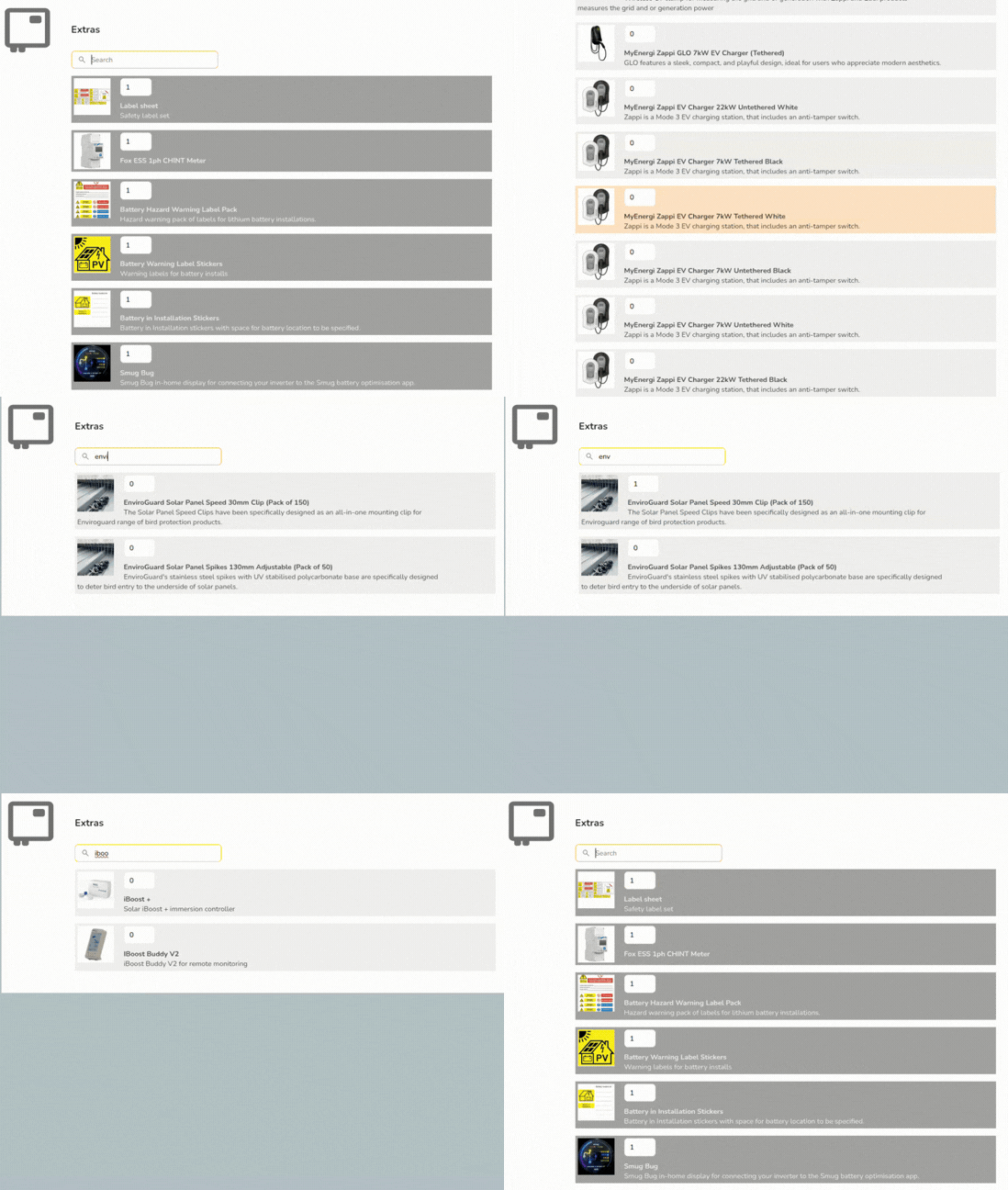
- Added a search bar to the 'Extras' page in the Electrical task to improve component filtering.
-
A new search bar at the top of the Extras task now filters the list as you type, filtering through the catalogue of extras to help you quickly find the item you need.
-
-
Search by product name or description.
-
Results update as you type, and you'll see a clear message if nothing matches.
-
Extras that Easy PV adds automatically still appear as before.

-
-
-
- Added a field to Connect Direct applications for additional attachments.
- Connect Direct applications now have an Additional attachments section, so supporting documents can go to the DNO with the application. Upload files from the project overview (up to 10MB each), then add them to the form.
Fixes
-
Fixed a rounding calculation flaw in non-MCS mode that triggered
NaNformatting issues, and corrected a PVGIS data hang that returned empty-%flags and froze the Performance screen. - Fixed a visual bug where GSE Ground Evolution panels were appearing partially hidden in the 3D model.
- Resolved a snapping bug in 3D and Magic mode where roofs couldn't be detected.
- Fixed an edge case where an obstruction completely covering a roof caused the program to crash.
New in August 2026
Updates
- Added an updated component editor for custom meters and isolators.
- Added note to Alpha ESS installers
- If you are planning your first Alpha ESS install you need to contact Alpha before the installation to be on-boarded and issued an installer license number which you will need in order to commission a system. Alpha will also be able to provide guidance and technical support to assist with your first installation: https://www.alpha-ess.co.uk/become-approved-installer
- Fastensol mounting has been reinstated on Easy PV now that it has an MCS certificate.
- The email notifying you when a document has been e-signed now directly links to the relevant project.
Fixes
- Correction to how Solarport systems are specced.
- Missing images in the proposal are skipped instead of preventing the PDF from downloading.
- Fixed an issue that prevented the Financial task and Customer proposal from loading due to a missing panel pitch and orientation.
- Fix to automatic shade analysis, providing more realistic performance projections.
New in July 2026
Updates
- Updated user interface of the project and component sharing modals.
-
Updated K2 wind uplift values in structural task inline with MCS BBA 7466.
- Clearer wording on the proposal when a grant is applied.
- Ensures when a grant is 'claimed afterwards' the correct effective cost is shown to the customer and the amount due to the installer remains accurate.
- Improvements to the task modal designs to support mobile viewing.
Fixes
-
Fixed some discrepancies between Easy PV and Solarport components.
- Fixed appearance of Solarport systems in 3D view.
- Improved the accuracy of the 3D model shading which was off by approximately 1 hour during summer (BST).
- Fixed an issue where changing the DC isolators wasn't carrying through to the next stage.
- Cloned roofs in roof outline mode are ignored in the overview image.
Smug: Smart battery optimisation
easy-pv.co.uk
Smug is a cloud application, a smartphone app and an in-home display for your inverter that work together to optimise the way your battery charges and discharges.
How does Smug work?
Smug uses weather forecasting and machine learning to understand how much energy the user consumes each day. It then predicts whether the user will have excess solar generation to sell back to the grid, or whether they will need to buy energy to cover their household use.
Where the user is on a time-of-use tariff, it will control their battery to export surplus energy at the best price, and buy any deficit at the cheapest time.
This can save the user £100s on their bills every year, depending on their tariff, usage patterns, and the size of their battery and inverter.
To find out more, please visit the Smug website! https://smug.energy/
How to interact with Smug in Easy PV
To include Smug in an Easy PV project, simply choose a compatible inverter and ensure that ‘Smug optimisation’ is selected in the consumption task.
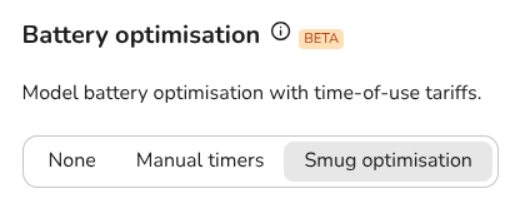
The Smug Optimisation toggle in the consumption task
How to include Smug by default
In your team settings, you can set Smug to be included by default.
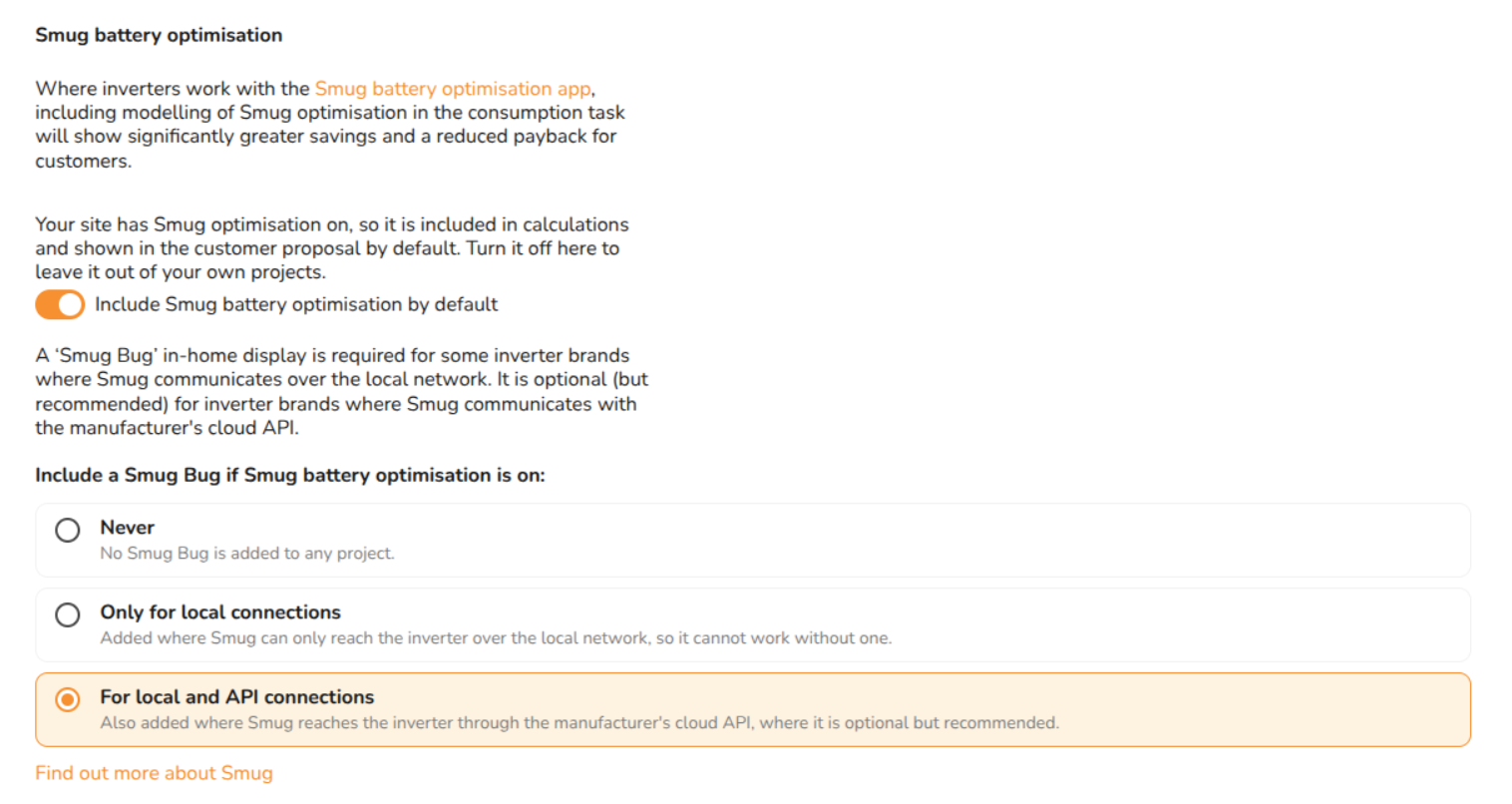
The Smug default toggles in User Preferences
How to find the optimisation statistics
Once Smug is included in a project, you will be able to view the optimisation benefit of Smug in the consumption task.
See below an example of Smug optimisation statistics in an Easy PV project.
Throughout this section, we will use an example that models a project of: 12 × 445 W panels, a Fox ESS 8 kW hybrid inverter and 3 × EP6-H Plus 5.21 kWh batteries on a home using 2,900 kWh a year.
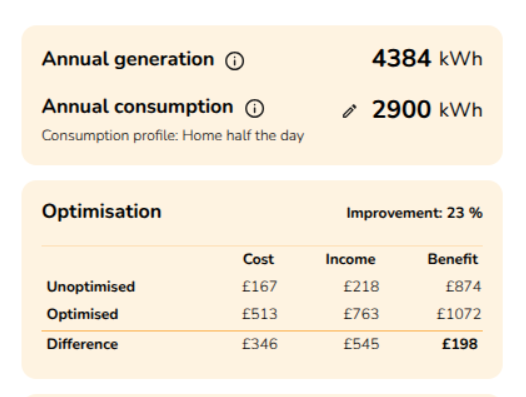
(Above) Example of optimisation statistics in the consumption task
You will also be able to find optimisation statistics in generated customer proposal documents.
This section generates estimates of financial returns. See below, the example customer's first year financial returns statistics. The rightmost section of the graph demonstrates Smug energy management's affect.
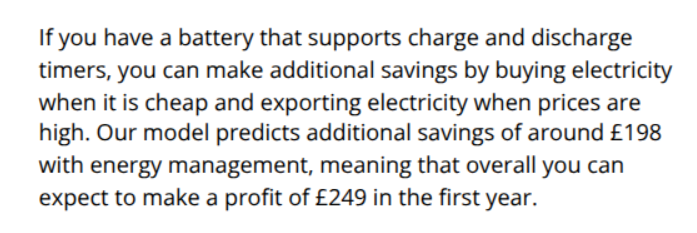
In this example (the same example project that we have been using throughout this thread), we can see an improvement in user savings of £198 (-£249 + -£51 = -£198). Therefore, the difference between an un-optimised system and an optimised one is a saving of £874 and £1,072.
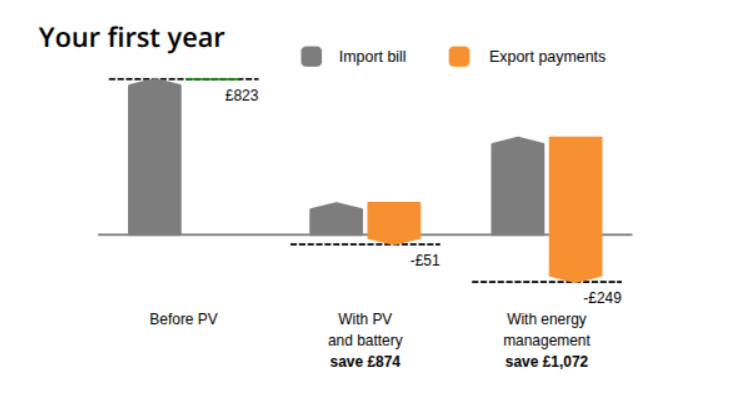
In the customer proposal, statistical details are laid out and explained below this graph in the Financial Benefits page (see below).
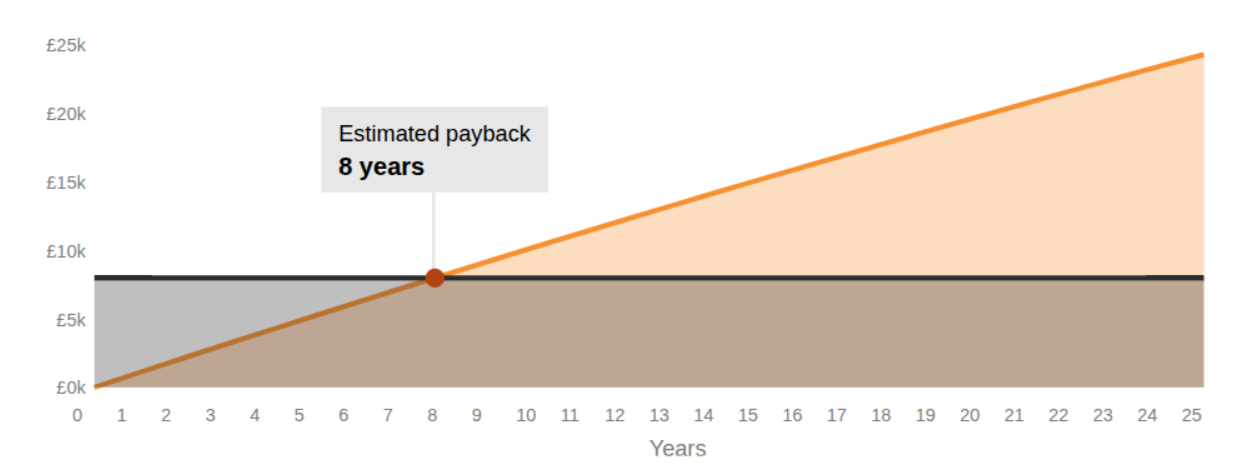
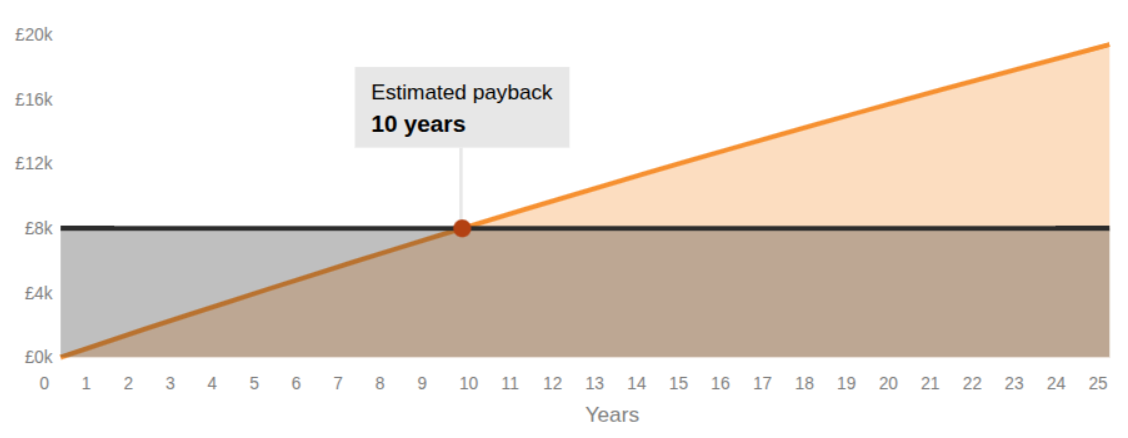
You will also be able to see the effect of Smug in the estimated payback period. For the example we have been using, the payback period is two years earlier with Smug optimisation.
With Smug:
Without Smug (the same example project, with Smug optimisation removed):
FAQs
Which inverters are compatible?
Smug works with Eleven Energy, FoxESS, Sigenergy and SolarEdge systems. Smug also works with legacy GivEnergy systems, where it allows users to control and monitor their systems without any connection to the GivEnergy cloud service.
Solax, Enphase, Solis, and Growatt compatibility is currently in beta testing and is expected to be released in Q4 2026.
Please see the Smug Compatibility for full details of which inverters and brands are compatible: https://smug.energy/help#compatibility
Smug is expanding further, and integrations for others brands will follow soon. Please get in touch via hello@smug.energy if you would like us to prioritise a particular manufacturer.
Still Need Help? / Want to know more?
Contact Support: If you've got further questions, get in touch with our support team at help@easy-pv.co.uk (UK). If you are experiencing a bug, to help us look into your issue faster, please include the email address of your account, the name of the project and screenshots of any unexpected behaviour.
The power of choice: Why flexible payment options are so important
Residential solar has moved firmly into the mainstream over the last few years, and the profile of the average buyer has evolved just as quickly. The days of selling exclusively to tech-savvy early adopters, eco-purists, or affluent buyers unfazed by the price tag are over. Today’s consumers increasingly view solar PV and battery storage as a meaningful financial investment that can help hedge against volatile energy prices and reduce long-term living costs.
In turn, the way installers sell solar PV and battery storage systems needs to adapt to modern consumer expectations. Today, buyers are offered more flexible ways to pay for everyday goods and services than ever before, meaning the "How do I pay for it?" question is just as critical for a solar installation as the hardware specifications or panel efficiency. By providing flexible payment and financing options, you can lower barriers to entry, accelerate sales pipelines, and empower customers with meaningful financial choices.
The value of consumer choice
When faced with a high-cost capital investment like a solar installation, consumers look for the same flexibility they enjoy when purchasing a car or a new kitchen. Forcing a one-size-fits-all, "upfront cash only" model can exclude a large portion of the market. By contrast, offering a choice between upfront staged payments and longer-term monthly finance options creates a win-win scenario.
-
For your customer: It helps shift their mindset from "Can I afford this right now?" to "Which of these payment options best fits my budget?" It allows them to align the ongoing monthly savings on their energy bills directly with their payment structures.
-
For your business: It reduces the length of the sales cycle, boosts project conversion rates, and minimizes the friction that often occurs between issuing a proposal and receiving a deposit.
Presenting payment choices clearly
Offering various ways to pay is only effective if the customer can easily understand them. The best place to map out these options is within a well-structured customer proposal, where the technical system design can be presented alongside the financial reality.
If you can make it easy for a customer to compare upfront staged payments against monthly finance options in the context of the system's forecasted financial benefits, the proposal helps them feel confident in their decision to commit. A customer can instantly see the relationship between their potential monthly outlay and their predicted energy bill savings. This turns abstract, long-term payback periods into an understandable cash flow reality, making the decision to move forward much easier to justify.
As we highlighted in our previous article on why customer proposals matter in solar PV, a well-structured document ensures that technical design, financial outcomes, and payment choices all support one another, removing ambiguity and providing the transparency consumers need.
This is where Easy PV's payment and finance functionality is so powerful for installers. Rather than needing to use complex tools or manually build spreadsheets, the platform integrates these financial pathways directly into the design and sales workflow. With just a few clicks, you can configure tailored payment options and consumer finance packages for your customers. Easy PV automatically presents these choices clearly within the final proposal document, turning a potentially complex sales hurdle into a seamless, professional experience that builds trust and wins jobs.
Get the numbers right
Of course, introducing flexible payment methods or monthly finance plans carries a heavy responsibility: your underlying financial assumptions must be relevant and clearly presented to the customer, and you need to make sure your quote is both technically and financially compliant.
This highlights the importance of using the right financial settings in Easy PV and making sure you seek the right advice and support when you start to offer consumer finance.
We recently launched a new Easy PV integration with FinMatch, a leading UK-based consumer finance platform, which makes it easy to offer FCA-compliant finance packages via the Easy PV customer proposal.
Installers can offer up to 12 months, 0% interest-free finance without FCA authorisation. FinMatch also helps installers obtain FCA credit broking permissions via their FCA Assist service – they handle the application process, including preparing your regulatory business plan, selecting the relevant permissions, so you can get approved seamlessly.
Sign up to FinMatch today using this link, then visit Easy PV to link your account. See full instructions in this guide to setting up FinMatch.
Unlock better systems and higher ROI
Interestingly, providing financial choice also changes what customers buy, not just how they pay for it. When only offered an all-upfront cash option, customers frequently compromise on system size or opt out of battery storage entirely to keep the initial price tag within an arbitrary cash budget.
When flexible payment options are on the table, the conversation shifts toward maximizing long-term value. (see Maximizing ROI: The installer's role in system optimisation and customer education). Spreading the cost makes adding a battery or optimizing a panel layout financially viable on a month-to-month basis. Armed with the right financial choices, customers are empowered to invest in fully optimized systems that yield far greater lifetime savings and a superior return on investment.
Written by Matt Agnes, Head of Software Sales at Midsummer Energy. May 2026
New in April 2026
Updates
- GSE landscape added for slate, plain tile and concrete tile roofs.
- Changed battery management warning in proposal so it displays as optional.
- Upgrading to Pro info now displays all features and new navigation bar logo for active Pro users.
- Q1 OFGEM price cap site level tariffs added for all users to select from.
- Semi-rigid bottom flashing added for portrait GSE.
- Compatibility warning given when selecting multiple inverters.
Fixes
- Fixed issue with detecting non-default AC isolator.
- Pitch of panels now factored into PVGIS profile in Consumption task.
- Footer image warning now not displayed when e-signing.
- Fixed discrepancies in Solarport BOM.
- Fixed bug that allowed you to string across roofs with different pitch or orientation without optimisers.
- Fixed how much flashing was specced for Solfit panels.
- Fixed bug where removing panels from a roof breaks the structural calculations.
- Deselected finance partner options now no longer displayed.
- Fixed formatting errors in order form.
- Removed MCS mention on 'Your Energy Explained' for PVGIS and NREL projects.
New in March 2026
Updates
- FinMatch loan integration launched.
- GSE flexible flashing drip (500m) hidden.
- K2 mounting hidden from plain tile roofs.
- Warning when tariffs are less than 1p (UK).
Fixes
- Fixed financial task issues for projects with empty inputs.
- Fixed panel allocation issues when using PVGIS or NREL performance data.
- Fixed bug where first shading group wasn't created in panel allocation with optimised systems.
- Auto page breaks in customer proposal include custom header and footer and footer sizing now consistent throughout proposal.
New in February 2026
Updates
- Inverter task: battery range expanded to allow more than 10 batteries on each inverter.
- Row spacing now used for Solarport mounting in panels task when adding panels with arrow keys.
- Changes to proposal message when battery optimisation isn't completed or enabled. This remains an optional feature.
- Magic mode roof scanning now enabled for medium resolution aerial imagery.
Fixes
- Fixed panel rendering issues for large 3D projects.
- Correction to AC isolator current calculation when using microinverters.
- Fix for overview 'Buy Now' link when using certain custom components.
- Fixed east west systems when the pitch of the panels was changed after completing performance task.
Speedy PV: turn curiosity into commitment
Demand is high, but so is customer expectation. Homeowners want clarity, immediacy, and trust long before they ever speak to an installer. And yet most installer websites still rely on the same two calls to action they’ve used for a decade: “Request a quote” or “Contact us”.
For years, the industry has followed a familiar rhythm: a homeowner makes an enquiry, an installer calls back (but not always), someone checks the roof on Google Maps or arranges a visit, and only then does the real conversation begin. It works but it’s slow, labour‑intensive, and increasingly out of step with how people expect to buy anything in 2026.
Speedy PV exists to offer a different kind of experience that answers questions instantly and helps installers spend less time qualifying leads and more time closing them. The companies growing fastest are the ones who’ve realised that a sales journey doesn’t always have to begin with a phone call. It might begin the moment someone wonders, “Could solar work for my home?”
Read on to learn how Speedy PV turns these moments of curiosity into momentum.
Why Speedy PV matters now
The way people buy solar has changed. They research online, compare options, read reviews, and expect to get a sense of cost and feasibility before they commit to a conversation. Traditional forms and call‑backs simply don’t match that behaviour.
Speedy PV meets customers on your website and provides them with:
-
Clarity via an instant roof scan and system design based on their property
-
Confidence via transparent pricing, savings and payback projections, and environmental impact information
-
Next steps via a professional estimate pack delivered straight to their inbox
For installers this can be a game‑changer, as you’re no longer asking visitors to simply “get in touch”. You’re giving them something genuinely valuable, and in return, they give you their details with far higher intent.
Turn curiosity into commitment
One of the most powerful things Speedy PV does is collapse the gap between interest and action. A homeowner arrives on your website with a question in mind... Could solar work for me? Then within minutes they’ve seen their roof scanned, their system outlined, and their potential savings laid out clearly.
That journey creates momentum. It transforms a passive browser into someone who has already pictured panels on their roof, already understood the value, and already taken a meaningful step towards a decision. By the time they reach your inbox, they’re not a cold enquiry. They’re a warm, informed prospect who has invested time in your brand and your process.
A first impression that sets you apart
Speedy PV doesn’t just streamline the early stages of the sales process - it elevates them. When a homeowner sees their roof automatically outlined, obstructions identified, and a realistic system size generated, it signals something important: this installer is modern, transparent, and easy to work with.
That impression matters. Many installers still rely on slow, manual quoting workflows that feel out of step with how people expect to buy anything today. Speedy PV gives you a way to stand out immediately, not by shouting louder, but by offering a smoother, smarter experience from the very first interaction. It’s a quiet competitive advantage which helps build trust before you’ve even picked up the phone.
A seamless bridge into your existing workflow
The value of Speedy PV doesn’t end when the homeowner hits “submit”. Behind the scenes, it feeds directly into Easy PV Pro, meaning half the work of building a project is already done by the time you open the lead.
The roof is drawn. The panels are placed. The inverter is selected. The electrical components are chosen. The performance is calculated. A full proposal is already taking shape. The kit list is ready to order.
Instead of starting from a blank canvas, your team begins with a strong, consistent foundation and one that reflects your preferred components, pricing, and design approach. And crucially, it still leaves room for what installers do best: refining the system, tailoring the layout, and applying the practical judgement that only comes from experience on real roofs.
Speedy PV accelerates the early stages, but it doesn’t constrain your expertise. It simply gets you to the meaningful part of the process faster, so you can focus on the conversations and design decisions that actually win projects.
And because every submission lands in your Easy PV Pro leads dashboard, it’s easy to keep momentum. You can review the estimate the homeowner received, send chaser emails, and convert the lead into a full project with a single click.
Make your marketing work harder
Even though this article isn’t about digital marketing, it’s worth acknowledging a simple truth: Speedy PV can amplify the return on everything you already do to attract customers.
Whether you’re investing in SEO, social content, PPC, email campaigns or local advertising, Speedy PV gives all that traffic a high‑conversion destination. It turns attention into action, and action into leads that are genuinely worth your time.
Built for installers who want to scale
Speedy PV is designed for businesses that want to grow without drowning in admin. It automates the repetitive work, captures the highest‑intent customers, and integrates seamlessly with the tools you already use. It’s fast to set up, easy to brand, and fully aligned with your pricing, your preferred kit, and your workflow.
For installers who want to operate with more speed, more clarity and more confidence, it’s a natural next step.
Ready to see what Speedy PV could do for your business?
If you’re curious about how Speedy PV might fit into your sales process, there are a few simple ways to explore it further:
-
Try the demo on the Easy PV website and experience the journey as a homeowner would
-
Speak to Chelsea Showering, our Speedy PV and lead generation expert about enabling Speedy PV on your account
-
Book onto a training session focused on Easy PV Pro and Speedy PV
-
Or, if you’re already using Easy PV Pro, follow this guide to learn how to get Speedy PV setup in minutes.
New in January 2026
Updates
- Added the option to clone inverters when using multiple of the same type. Stringing is copied by default.
- New bulk update options for all DC isolators and cables within the electrical task.
- MCS handover document added.
- Signature date is now auto-completed when e-signing.
- Improved how GSE trays are specified relative to panel size. Easy PV will now always select the minimum compatible size.
- BirdBlocker clips are now specified based on panel frame width.
- Extra BirdBlocker clips are only specified when required.
- Added way to easily set up payment after a free trial of Easy PV Pro.
- One Fastensol L Bracket is now specced per hook for Fastensol Standing Seam systems, replacing the Fastensol cross connect.
Fixes
- Fixed issues with east-west mounting and panel allocation.
- Corrected the system overview summary generated in the proposal when both string and hybrid inverters are selected.
- Updated DNO form rounding to 2 decimal places (e.g. 3.68 kW no longer rounds to 3.7 kW).
- Fixed incompatible pan tile hooks being specified for Fastensol and Renusol flat tile roofs.
- Financial task rounding now respects the selected currency rather than defaulting to 1 decimal place.
- Fixed Pro account financial setting rules that weren't working correctly for Admin role and added Owner role.
- Updated MCS012 certificate used in the Structural task for Fastensol pan tile hooks.
Easy PV Pro: help your team work more efficiently
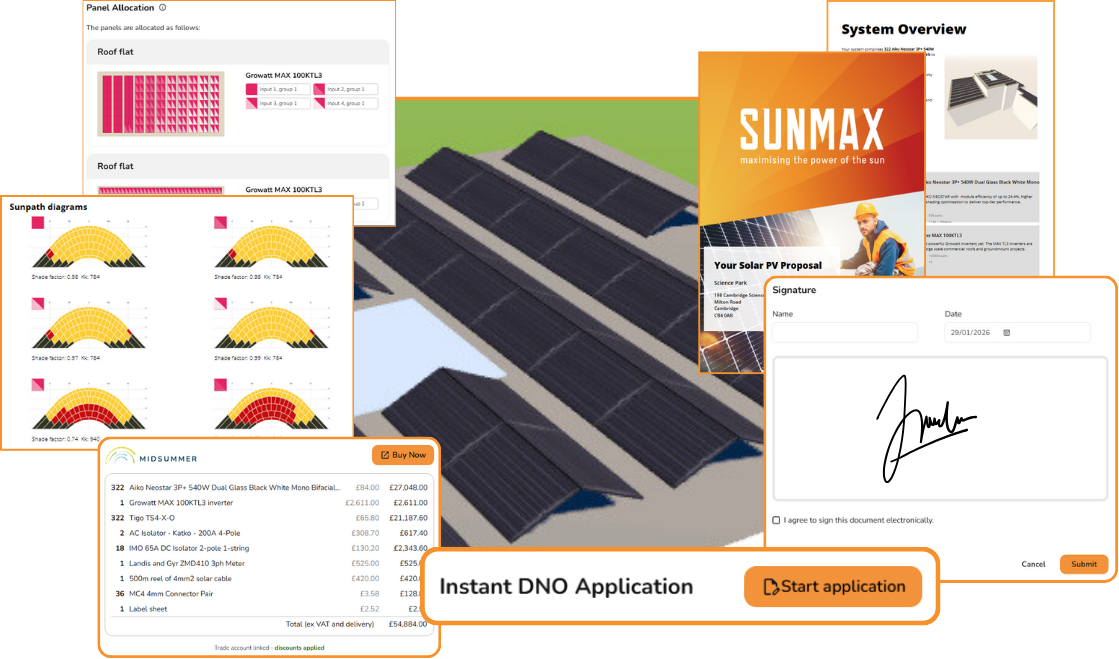
Running a solar business today means juggling a lot at once: fast‑moving leads, complex designs, tight installation schedules, regulatory paperwork and a customer base that expects clarity at every step. As your team grow, the challenges grow too, from more people touching the same projects, more room for inconsistency, and more opportunities for things to slip through the cracks.
Easy PV Pro is designed to give installers a shared workspace where projects stay organised, pricing stays consistent and communication stays clear. Instead of relying on scattered tools and manual processes, Pro features help your team work in a single, structured environment from first contact to final handover.
1. Team-wide settings and workflows
As teams grow, consistency becomes one of the biggest challenges. Two designers might price the same job differently. A surveyor might forget a detail that slows down the installation. Someone might save documents in the wrong place, leaving others searching for information. Pro tackles this by giving your team a shared place to work end ensures everyone works in the same way.
-
Team‑wide settings ensure everyone uses the same components, defaults and pricing logic.
-
Role‑based controls protect sensitive information and prevent accidental changes.
-
Shared project access means anyone can pick up where someone else left off.
- Configure email sending to come from an email address you own.
Read more about managing Pro team settings.
2. Quick lead generation & system designs
The early stages of a solar sale are often where teams lose the most time. You need to qualify interest quickly, understand whether a customer is a good fit and produce a proposal that’s accurate enough to move the conversation forward – all without sinking hours into manual modelling. Easy PV Pro can help in two ways.
 Generate and qualify leads with Speedy PV
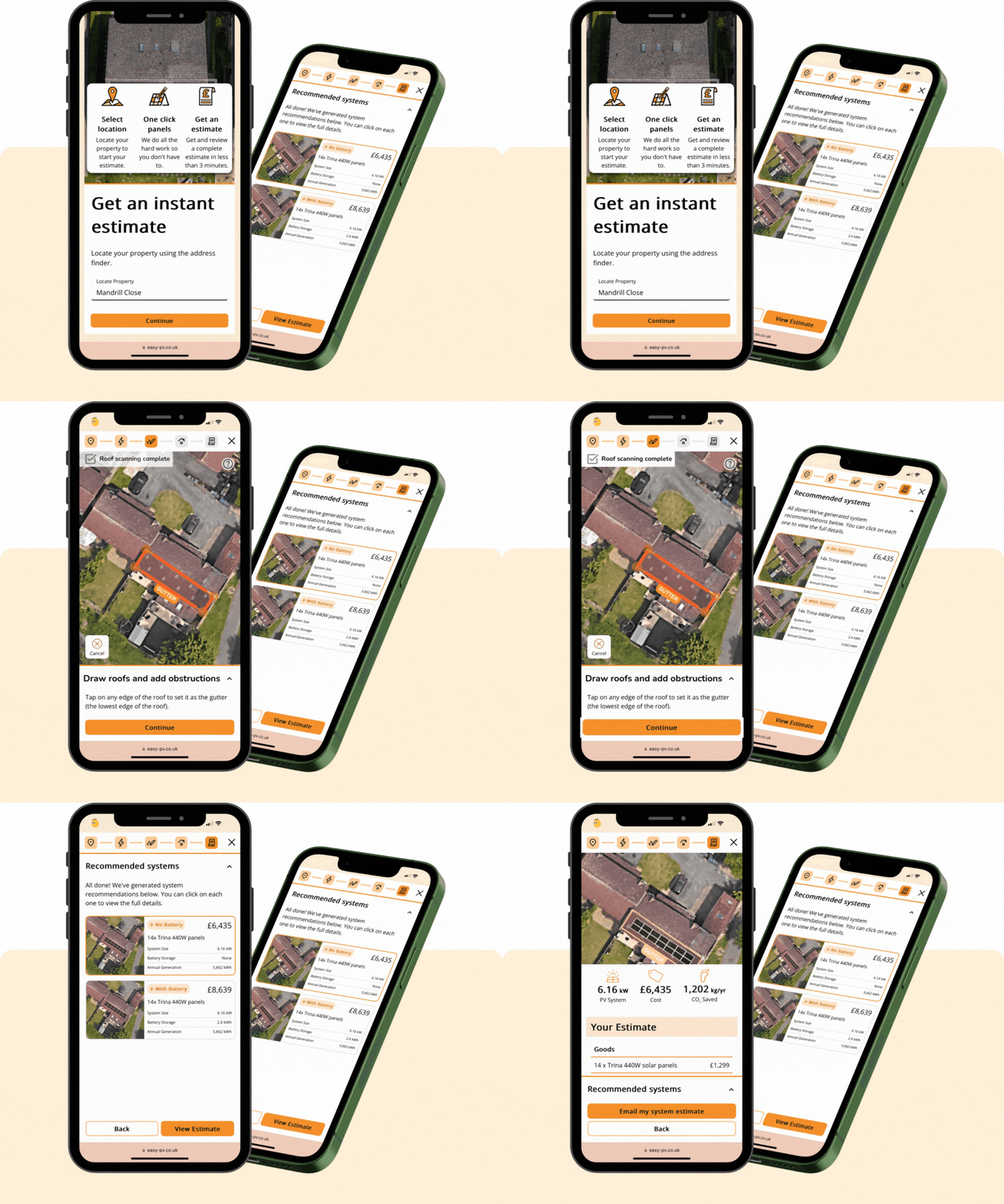
Speedy PV is a paid add‑on that works alongside Easy PV Pro. Once enabled, you can embed the tool on your website and let visitors generate an instant system design and cost estimate without you lifting a finger. It helps you capture interest early, filter out low‑intent enquiries and focus your time on customers who are genuinely ready to move forward. Leads will appear in the Easy PV leads dashboard for all your team to access, and you can convert them to a full project in a single click. Find out how to get set up with Speedy PV.
 Instant 3D designs & shade analysis
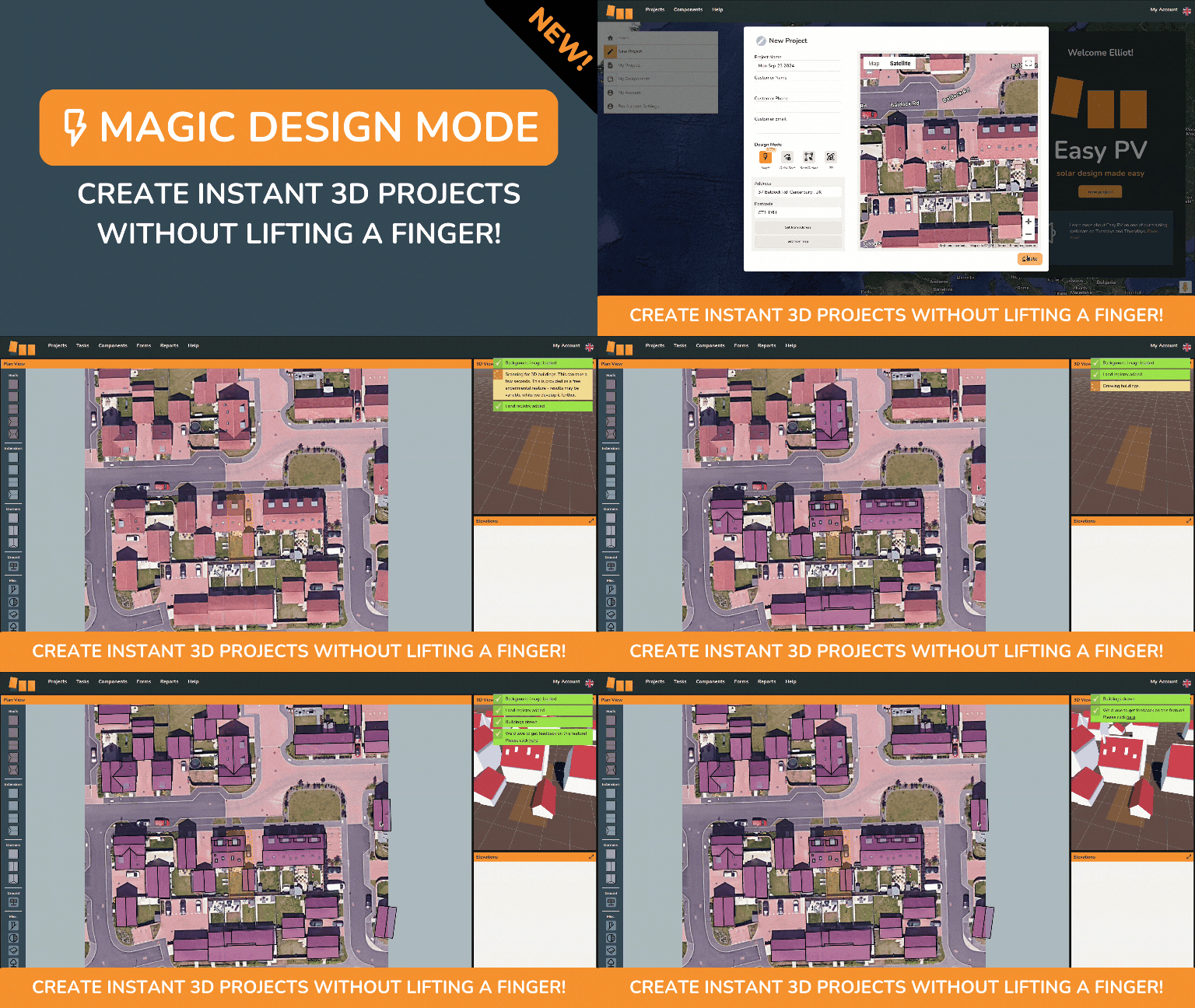
Easy PV's Magic Design mode helps you quickly and accurately generate a full 3D model of the property and surrounding buildings, complete with roof pitch, orientation and shading analysis. This gives your team a reliable design foundation in seconds, allowing you to produce accurate proposals without the usual back‑and‑forth or manual modelling. It's one of four design modes available in Easy PV.
3. Integrated survey functionality
The value of surveys and capturing all the information required for a successful installation is often overlooked. Pro's built in survey features make it easy to ensure your team can do this efficiently.
-
Pre-installation survey tasks Surveyors can complete a standardised survey directly within the project. This ensures all required information (like roof details, electrical setup, access notes, customer preferences) is captured consistently and passed cleanly to the design and installation teams.
-
Installation record tasks After the job is complete, installers can record key details in a structured installation record. This creates a consistent, auditable record of what was installed, how it was configured and any site‑specific notes that may be important for future maintenance or customer support.
Read more about Easy PV's survey functionality.
4. Consistent, professional proposals every time
Your proposals should look and feel like your business. With Pro, you can customise your branding, cover letters, terms and financial settings so every proposal is consistent – no matter who creates it. Customers receive branded emails, clear payment options and documents they can e‑sign instantly.
-
Customisable proposal documents let you add your branding, a cover page, an “About us” section and your own terms and conditions.
- Payment and finance options gives customers flexibility in how they pay.
- Send emails to customers directly from Easy PV
-
E‑signing removes friction from the contract stage.
- Manage additional documents required for the sale, like letters of consent, scaffolding request forms etc.
If you’d like to learn more about how strong communication, clear proposals and customer guidance contribute to better outcomes, these articles offer helpful context:
5. Keep projects organised from start to finish
As projects move from lead to design to installation, information can easily become scattered. Easy PV Pro helps you bring more of this together so you have a single source of information. Here’s how the Pro functionality keeps projects structured and on track:
Project status tracking: Projects can be sorted into statuses, giving you a clear overview of what stage each project is at.
Pre- and post-installation surveys: Help capture all project and install information in a standardised way.
Integrated email sending: Emails can be sent directly from Easy PV, with project documents attached automatically.
E‑signing for customers and your own team members: Signed documents are stored automatically in the project. This removes the friction of downloading PDFs, chasing signatures or dealing with scanned copies.
DNO applications via Connect Direct: Project data is pre‑populated into DNO forms, and the ENA Connect Direct integration streamlines the submission process, reducing admin time and minimising errors.
Centralised document storage: All project files – surveys, proposals, reports, customer documents – can be stored in one place, with no need for a separate QMS system. Easy PV's built in forms and reports features let you generate key project documents:
- MCS commissioning checklists
- DNO forms (including G98, G99, G100 forms)
- Letters of consent
- Cooling off waivers
- Survey reports
- Electrical installation certificates (a requirement of BS 7671)
- Schematics/SLDs
- Scaffolding quote requests
- PV array test reports
5. Quicker DNO applications
Submitting DNO applications can be one of the most time‑consuming and error‑prone parts of a solar project. Easy PV Pro allows you to submit DNO applications via Connect Direct and get instant approvals. Project and survey information is pre‑populated to reduce manual entry, cut down on mistakes and help ensure applications are submitted correctly the first time. It also keeps a clear record of what was submitted and when, making it easier for your team to track progress and follow up when needed.
6. Open APIs for deeper integration
Your Pro subscription will give you access to our Open APIs that let you connect Easy PV directly with the other systems your business relies on. Whether you’re managing leads, syncing customer records or automating internal workflows, the APIs give you the flexibility to integrate Easy PV into your existing processes without workarounds or manual data entry. With the APIs, you can:
-
Pull project data and documents into your CRM or ERP so your sales, operations and finance teams always have the latest information.
-
Push customer or lead information into Easy PV to create projects automatically and reduce admin.
Read our developer guidelines for more information.
Go further with an Enterprise solution
For businesses that need even more control, automation and oversight, our Easy PV Enterprise solutions takes things further. Enterprise is designed for larger teams and multi‑branch operations that need advanced permissions, deeper reporting, custom workflows and tighter integration with their existing systems. If you’re scaling rapidly or managing multiple teams, Enterprise gives you the structure and visibility to keep everything running smoothly at volume.
Contact us for more information about our Enterprise solutions.
The importance of using the right financial settings in Easy PV
The default financial settings you configure in your Easy PV account provide the baseline assumptions for every project. They save time by pre‑populating proposals with consistent values, but more importantly, they ensure that you can present customers with credible, compliant, and transparent projections. This article explains the importance of configuring settings appropriately.
Best practice checklist
-
Review defaults regularly to ensure they reflect current market conditions.
-
Separate general inflation from energy inflation (import/export tariffs).
-
Use realistic degradation rates for panels.
-
Configure tariffs to reflect current supplier offers.
- Document assumptions clearly in proposals, framing them as estimates, not guarantees.
-
Use defaults to create a consistent baseline, then adjust project‑specific values where needed.
Important information about inflation rates
There are two ways to set inflation rates in Easy PV. Understanding the difference is important and will affect the accuracy of the financial projections and the calculated benefits.
General inflation
This is the base inflation rate that will be applied to all project projections by default. This should be a sensible economic inflation rate that is realistic to apply across the full project term.
-
You can set the default value in your account preferences (this can be overwritten in the financial task settings on a per-project basis)
- You should refer to relevant government guidance for setting this value, for example data published by the ONS in the UK or by CSE in Ireland.
Energy inflation
Energy inflation can be configured separately for your default tariffs or on a per project basis in the financial task and is specific to import and export tariffs. This distinction is crucial: energy prices often rise faster than general inflation. By setting the indexing on tariffs you can model scenarios where electricity costs increase more steeply than other household expenses, or where export payments might not grow as quickly due to wider market influences.
Choose how energy inflation should be indexed by selecting from the following options:
- Indexed to inflation - this means it will increase in line with the general inflation rate applied to the project.
- Indexed above inflation - this means the energy price will increase by a percentage amount on top of the general inflation rate. For example, if your general inflation rate is 3% and you set 2% above inflation, the inflation applied to the tariff rates will be 5%.
- Fixed indexing - this will let you choose a different fixed inflation rate to apply.
- None - this will keep the rate the same for the full projection term.
Why financial defaults matter
Defaults underpin calculations of payback, savings, and environmental benefits. If they’re set too optimistically, customers may lose trust; if they’re too conservative, you risk underselling the benefits of solar PV. The goal is to strike a balance: accurate, realistic, and easy to understand.
Build trust with customers
-
Customers rely on your proposals to make significant investment decisions.
-
Clear, consistent defaults show that your calculations are grounded in industry‑standard assumptions rather than guesswork.
-
Transparency about inflation, tariffs, and degradation rates builds confidence and reduces the risk of disputes later.
-
Read more about why customer proposals matter in solar PV
Ensure compliance
-
Setting realistic defaults help align your proposals with MCS requirements and other industry standards.
-
Using recognised assumptions (e.g. panel degradation rates, tariff structures) ensures your documents stand up to scrutiny.
Save time and reduce errors
-
Defaults pre‑populate key values, so you don’t have to re‑enter them for every project.
-
This reduces the chance of mistakes, especially when working across a team.
-
Consistency also makes proposals easier to compare and benchmark.
Reflect real‑world conditions
-
Energy prices often rise faster than general inflation. Easy PV allows you to set energy inflation separately from general inflation, so your projections reflect this reality.
-
Defaults ensure that lifetime savings are modelled realistically, avoiding overly optimistic payback claims.
-
By indexing tariffs and costs to inflation, you can show customers how their system might perform under changing market conditions.
Communicate potential ROI
Every homeowner investing in solar PV and battery storage is seeking a positive return on investment (ROI) alongside environmental benefits.
- Easy PV goes beyond simple design and quoting and allows you to proactively model system benefits based on the customer’s consumption profile and the impact of TOU tariffs and energy management options.
- By modelling tariff scenarios, Easy PV helps installers configure the right financial settings at the design stage and explain to customers why reviewing tariffs regularly is essential.
- This transparency builds confidence, validates ROI, and strengthens the reputation of these technologies and the industry.
- Read more about maximising ROI.
Practical guidance is available in the following user guides:
Understanding energy management options
What is energy management?
Energy management is the process of controlling how you use the energy a solar PV system generates and how and when energy is imported from, or exported to the grid. Instead of simply generating solar power and using it as it comes, you can match usage to the times when electricity is cheapest or most abundant.
In our article on Why customer proposals matter in solar PV, we explained how proposals should give customers clarity about tariffs and savings. Energy management is the practical next step — it’s how you turn those forecasts into real‑world outcomes.
Why is it beneficial?
- Lower bills: Shift usage to off‑peak times or use stored solar energy to reduce reliance on expensive grid electricity.
- Better ROI: Batteries and solar systems deliver more value when paired with smart scheduling.
- Grid independence: Managing when you import and export power increases self‑sufficiency.
- Environmental impact: Using more of your own clean energy reduces carbon emissions.
As explored in Maximising ROI through energy management, it's essential that your customers understand the benefits of choosing the right tariff and configuring charge and discharge times to deliver the best financial outcomes. Energy management is the tool that unlocks those benefits.
What’s supported today?
You have several options for managing energy, depending on your system and provider:
-
Manual configuration:
Set charging/discharging schedules yourself (e.g. “charge battery at night, discharge in the evening”). Simple, but requires regular attention to tariff changes. -
Energy company control:
Some suppliers offer “smart tariffs” where they automatically control when your battery charges or when appliances run. This can optimise savings, but you give up some control. -
Third‑party apps and devices:
Independent apps or energy management platforms can integrate with your inverter, battery, or smart meter. They often provide dashboards, automation rules, and optimisation based on real‑time prices. -
Hybrid approaches:
Many systems allow a mix — for example, you set a baseline schedule manually, but your supplier or app can override it when tariffs change.
Ways you can do this
- Time‑of‑use scheduling: Align battery charging and appliance use with cheaper tariff periods.
- Load shifting: Move high‑consumption tasks (washing, EV charging) to times of surplus solar or low grid prices.
- Automated optimisation: Use apps or supplier platforms that adjust settings in real time.
- Integration with smart meters: Allow systems to respond directly to half‑hourly tariff data.
Modelling energy management in Easy PV
Easy PV lets you model how energy management settings affect system performance and customer savings through the Consumption Task.
How you use it
- Annual consumption inputs: Enter the property’s annual usage from bills, typical profiles, or smart meter data.
- Tariff configuration: Select the customer’s current tariff and any proposed new tariff to compare savings.
- Energy management options:
- Export limitation: Apply an export cap if required by the DNO.
- Forced charging/discharging: Define periods when the battery should charge or discharge to/from the grid, such as overnight charging on off‑peak tariffs.
What you see
- Generation and consumption profiles: Graphs showing direct use, battery storage, and exports.
- Import/export flows: Annual and daily views highlighting when grid imports are highest and when exports peak.
- Financial benefits: Costs and earnings based on tariffs, showing how energy management impacts bills.
- Battery utilisation: Insights into how effectively the battery is used across the year.
Why it matters
By modelling energy management in Easy PV, you can demonstrate not just the technical design but the real‑world financial and behavioural impact of different settings. This helps you set realistic expectations and show customers how their system interacts with tariffs, batteries, and the grid.
Written by Matt Agnes, Head of Software Sales at Midsummer Energy. November 2025
Why customer proposals matter in solar PV
Designing and selling solar PV systems isn’t just about technical accuracy. It’s about helping customers understand what they’re investing in and how their choices affect long‑term savings. A well‑structured proposal document can make the difference between confusion and confidence.
Easy PV’s customer proposal is designed with this principle in mind: turning complex system data into clear, practical information that supports both installers and homeowners. More importantly, it reflects a wider truth in our industry — that compliance, transparency, and education are as critical as the technology itself.
Clarity without oversimplification
- Supporting MCS compliance: The proposal is structured to help installers ensure they meet the requirements of the Microgeneration Certification Scheme (MCS). By including performance calculations, shading methodology, and clear disclaimers, it supports installers in delivering proposals that align with industry standards.
- Context‑aware content: The proposal adapts to the system being designed — PV‑only or PV plus battery storage — so customers see the information that matters for them.
- Plain language explanations: Technical elements such as orientation, shading, inverter capacity, and storage behaviour are explained with concise notes and visuals.
- Clear figures: Forecasts for generation, expected bills, and payback are presented in a way customers can relate directly to their household costs.
This balance of compliance support, clarity, and detail is what builds trust. Customers don’t need every engineering calculation, but they do need enough context to feel confident in their decision.
Transparent forecasting
The proposal makes it straightforward to compare the tariff a customer is currently on with a proposed new tariff, showing how the right choice can boost savings when paired with smart energy management settings.
It also gives installers a way to explain how customers can maximise system benefits — for example, by modelling charging and discharging schedules for batteries (see our article on maximising ROI through energy management).
These figures are forecasts, not guarantees. Tariffs change: time‑of‑use rates are updated, new products appear, and export rates can fall. Easy PV provides the tools to configure tariffs accurately at the design stage, but it’s the installer’s responsibility to set expectations clearly and explain that ongoing tariff reviews are essential to sustaining ROI.
Customer education that sticks
-
Link settings to bills: When battery storage is included, the proposal explains how off‑peak charging and peak‑time discharging work in pounds and pence, not just kWh. See Understanding energy management options for more context.
-
Show consumption interaction: The proposal connects household demand patterns to generation and storage behaviour, so customers see why their usage profile matters even with PV‑only systems.
-
Confidence post‑install: Clear expectations reduce “what did I buy?” queries and help customers understand what to check if bills don’t match the forecast.
Education is not an add‑on; it’s central to helping customers realise the forecasted savings and payback period.
Payment and financing options built in
A proposal is most effective when it connects technical design to financial reality. Easy PV’s new payment and financing features allow installers to include clear options for how customers can pay for their system. Whether it’s upfront, staged payments, or financing plans, customers see the investment alongside the savings forecast. This makes the proposal a complete package: design, financial outcomes, and payment pathways all in one place.

Pro features that streamline sales
With Easy PV Pro, you'll gain access to enhanced proposal features that make the sales process smoother and more professional:
-
Custom branding – Produce documents that reflect your company identity while maintaining Easy PV’s clear structure.
-
Emailing and e‑signing – Send proposals directly and collect signatures without leaving the workflow, speeding up approvals and reducing friction.
-
Project document management – Keep proposals, revisions, and related files together, so your team can retrieve the latest version and track changes easily.
These features make proposals easier to issue, approve, and manage which in turn reduces delays between design, acceptance, and scheduling.
Final thoughts
Easy PV’s customer proposal document is about clarity, transparency, and practicality. By combining system design outputs with tariff comparisons, Pro features, financing options and MCS compliance, it helps installers deliver proposals that customers can trust and act on. That’s how projects move from technical designs to real‑world outcomes that benefit both homeowners and businesses.
Written by Matt Agnes, Head of Software Sales at Midsummer Energy. November 2025
Maximizing ROI: The installer's role in system optimisation and customer education
Every homeowner investing in solar PV and battery storage is seeking a positive return on investment (ROI) alongside environmental benefits. As experts in the field, we (the installers and solutions providers) carry a crucial responsibility: ensuring customers not only get a great installation but also the forecast savings.
Speaking from personal experience as a new homeowner navigating the process of turning a 'tired' ex‑council terraced house into an environmentally friendly home, I’ve realised just how much more the industry can do to inform and educate consumers. The potential of clean energy solutions is immense, but the full benefits are only realised when homeowners are sufficiently equipped to understand their choices and take full advantage.
Three pillars of a successful project
-
Appropriate system design – Specifying a solution that’s suitable for the customer’s needs.
-
Realistic financial estimates – Clearly communicating performance and financial outcomes to justify the investment.
-
Customer education – Providing the knowledge and tools for the customer to achieve the savings forecast at the sales stage.
Why customer education is so important
Focusing on the third pillar, customer empowerment is what separates a decent installation from a system that delivers on its full potential. Investing an extra five minutes in education is the best investment you can make in your business's reputation.
Navigating tariff complexity
Energy tariffs, particularly time‑of‑use (TOU) and others optimised for solar and batteries, are inherently confusing. Homeowners need a trusted expert to explain how the storage system should be programmed to maximise charging during cheap, off‑peak periods and discharge to minimise grid consumption during expensive peak times. Installers must be the translators, turning complex data into clear financial instructions. There are several ways energy management can be configured: manually, via the energy supplier, or through third‑party apps (outlined in understanding energy management options).

Important note: Tariffs change over time. TOU rates are updated, new products appear, and export tariffs can go down. That means customers must be encouraged to check they’re always on the best tariff for their usage profile. A battery configured perfectly today may underperform tomorrow if the tariff changes. Helping customers understand this dynamic is central to maximising ROI.
Ensuring performance optimisation
A battery is only as good as its settings. If a system is incorrectly configured, it may charge or discharge at sub‑optimal times, drastically eroding the promised financial benefit and return on investment. Aligning the battery's operational settings with the chosen energy tariff and the customer’s unique consumption profile is a non‑negotiable part of the installation process.
Driving customer satisfaction
When the monthly energy bill consistently validates the projected savings, it doesn’t just benefit the customer, it is good for business and for the industry. Thrilled customers provide positive reviews and, more importantly, valuable referrals. Turning a great installation into a great financial outcome for the homeowner is the surest path to sustained business growth.
How Easy PV helps in practice
Using the right software solutions becomes invaluable in this process. Easy PV goes beyond simple design and quoting and allows you to proactively model system benefits based on the customer’s consumption profile and the impact of TOU tariffs and energy management options.
-
Consumption task – Input or model a customer’s actual consumption profile to align system design with real usage patterns. Configure tariffs and energy management settings.
-
Financial task – Forecast costs vs benefits over the lifetime of the system. Demonstrate realistic savings forecasts.
-
Customer proposal – Generate clear, visual proposals that explain not just the hardware, but the financial logic behind it. Customers can see how system settings and tariff choices translate into annual savings. Take a look at our article about why customer proposals matter.
By modelling tariff scenarios, Easy PV helps installers configure the right financial settings at the design stage and explain to customers why reviewing tariffs regularly is essential. This transparency builds confidence, validates ROI, and strengthens the reputation of these technologies and the industry.
Practical guidance is available in the following user guides:
Written by Matt Agnes, Head of Software Sales at Midsummer Energy. November 2025
New in September 2025
We’re excited to introduce several powerful updates to Easy PV that enhance financial modelling, battery management, and customer proposals.
- You can now configure flexible payment options and financing for your projects
- Model the financial benefits of charging batteries from grid or discharging batteries at peak times
Please note that these features are currently in BETA - please contact our support team if you encounter any issues.
Manage payment and finance options
You can now configure flexible payment options for your projects and make it easier than ever for your customers to move forward with their install.
-
Pay-in-full options - Include deposits and stage payments tied to specific project milestones.
-
Finance/loan options - Add details of financing plans available to your customers.
Once set up, choose which options to include in your projects via the Financial Task. These will appear in the customer proposal, complete with tailored cashflow and payback pages.
Refer to the guides on the Easy PV help portal to find out how to configure payment and finance options via your account preferences and how to enable payment options for your projects.
Battery management: charge from grid/discharge to grid
Model the financial benefits of smart battery management for reduced payback periods and improved return on investment for your customers.
-
Charge from grid during off-peak hours (e.g. overnight)
-
Discharge to grid during peak hours for higher export rates
Set charge/discharge times in the Consumption Task, and Easy PV will forecast annual energy flows and financial returns. The financial benefits of battery management will also be included in financial projections in the Financial Task and reflected in the Customer Proposal.
Refer to the guides on the Easy PV help portal to find out how to configure Battery Management for your projects
Customer Proposal report enhancements
To support these new features, we’ve updated the Customer Proposal with new pages and other enhancements:
-
Financial Overview Page - Summarizes key financial benefits, including battery grid interactions.
-
Order Form Page - Displays available payment options and supports e-signing (Pro users only).
-
Cashflow Pages - One for each payment option, showing:
-
Payment type
-
Expected payback period
-
Lifetime cost/benefit projections
-
Note: The order of some proposal pages has changed for an improved information flow.
We’re excited to see how these new features help you deliver smarter, more flexible solar solutions. As always, your feedback helps shape what comes next - so don’t hesitate to reach out.
New in February 2025
- Birds eye view overview images: you now have the option to include birds eye view of panels on roof as overview image on the proposal when designing in 3D mode.
- Capturing contact information in Speedy PV: you can now configure your Speedy PV so contact details are required before the estimate is shown.
New in January 2025
- Multiple battery storage systems factored into calculations on Easy PV consumption task.
- Updated functionality to change currency in Easy PV.
New in December 2024
- Inclusion of G100A and G100C forms in Easy PV
- Easy PV Pro: introduced compatibility with OAuth 2.0 authentication for emailing, in addition to SMTP options, for compatibility with Office 365.
New in November 2024
- Updates to tariffs. Details on these changes can be found here.
-
- Settings in financial task, consumption task and user defaults are now consistent.
- User default tariffs will be applied for MCS and Easy PV self-consumption calculations in the financial task.
- Updates to 3D studio roof menu to adjust roof covering, eaves depth and ridge and hip symmetry.
- Squares added to schematic task.
- Polygonal roof obstructions can be added in quick roof design mode.
- CSV settings in financial task modal moved to new modal when downloading CSV. Old option to edit quote view can be accessed before generating customer proposal to adjust both the customer proposal and Easy PV project report.
New in October 2024
Various small updates and enhancements have been rolled to the live site. This includes:
- New refresh options in the financial task so you can reset the goods and services costs separately.
New in April 2025
Updated performance & consumption tasks
We're rolling out new features and improved user interfaces across the Performance and Consumption tasks in Easy PV. These updates will help you generate system performance and consumption projections more accurately than ever.
We've summarised the key changes below, but we also recommend reading the full user guides to understand how to use the new versions of these tasks and the new features we've added: Performance task user guide and Consumption task user guide.
Improved user interfaces
We've been working on improvements to many of the user interfaces in Easy PV to make them more intuitive and efficient. These UI upgrades are designed to make it quicker and easier to complete tasks and take full advantage of the new and existing features.
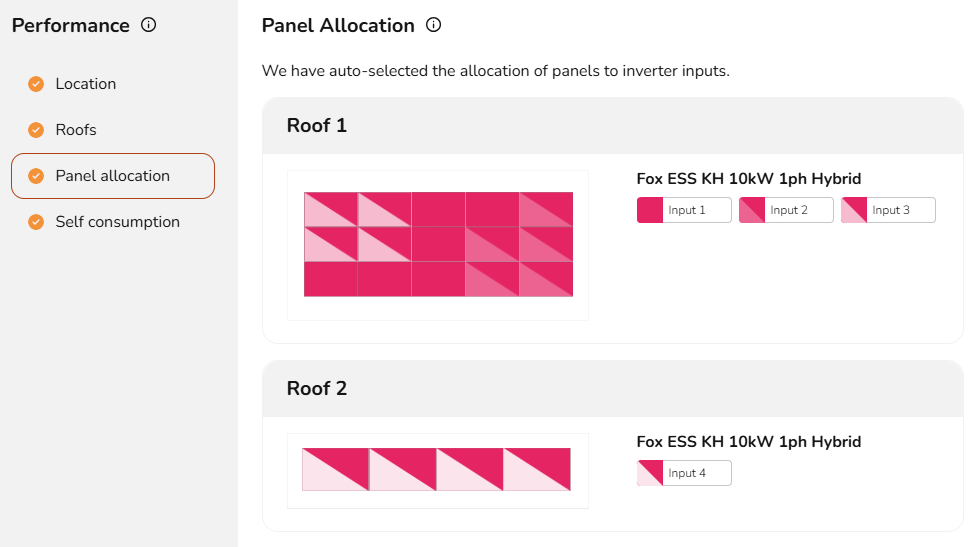
Automatic panel stringing
We've introduced automatic panel stringing, which recommends a suitable way to string panels based on the roofs and inverter inputs in your design. This new feature is a real time-saver—especially for larger systems—by helping you set up strings quickly and efficiently. You can manage preferences on your account to set how you want automatic panel stringing to apply. See below for more information.
New domestic and commercial consumption profiles
You can now choose from a variety of domestic and commercial consumption profiles to build an accurate picture of energy usage throughout the year. A consumption profile calculates when energy is consumed—both annually and on a daily basis. For example, in a domestic home, most energy is typically used in the early morning and evenings. In contrast, an office profile reflects higher energy use during typical working hours, from around 09:00 to 17:00.
The following commercial profiles are available
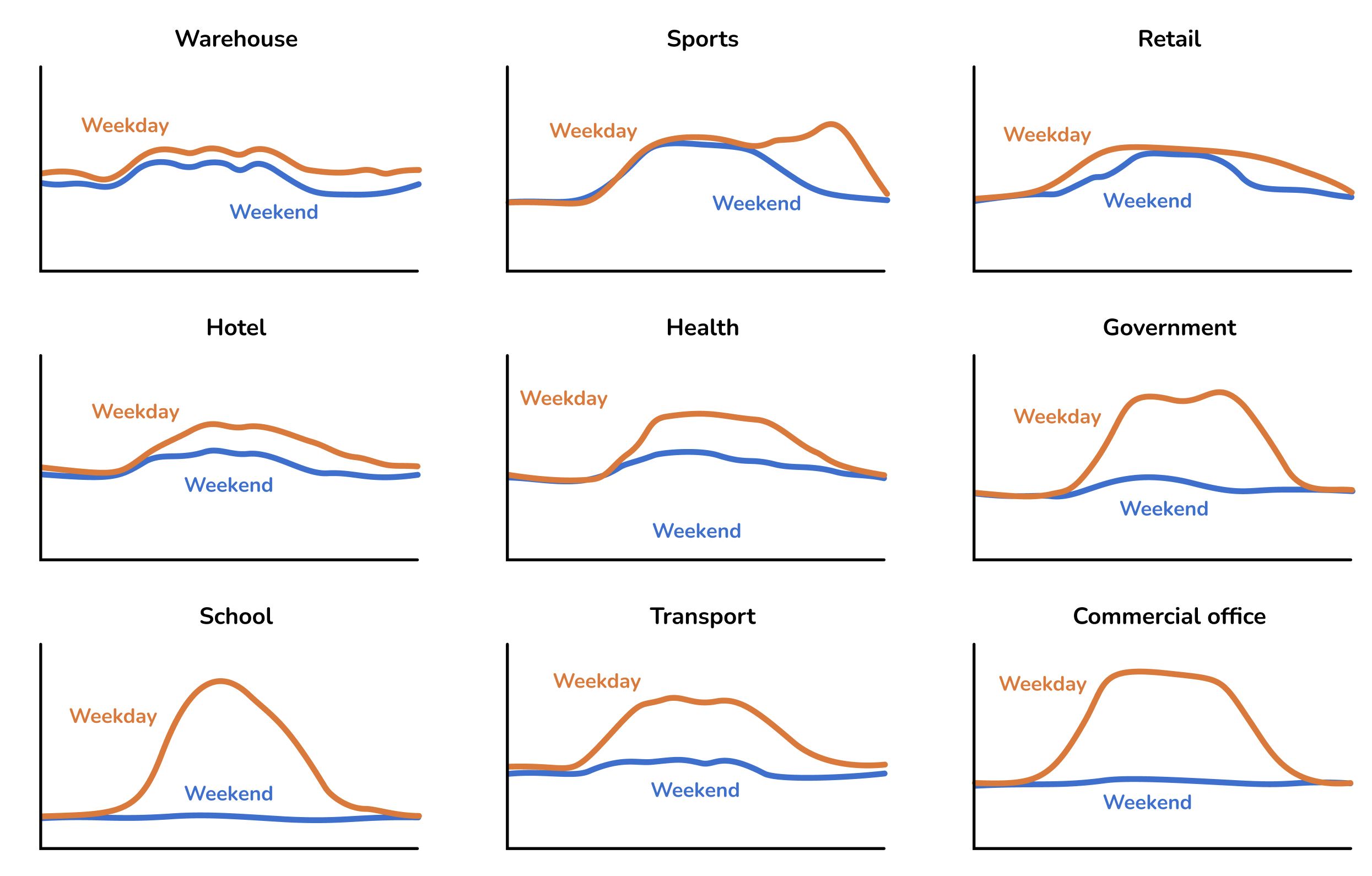
Configure export limits and visualise export and inverter clipping
We've added support for setting export limits where required by the DNO. This ensures your system design complies with local network requirements and accurately reflects any restrictions on energy export and the potential financial benefits of the system.
You can toggle on clipping in the consumption task to show relevant information in the charts. This makes it easier to visualise when and how much potential generation is being limited by the inverter or by export limits, helping you make more informed design choices and assess whether an inverter is appropriately sized for the system.

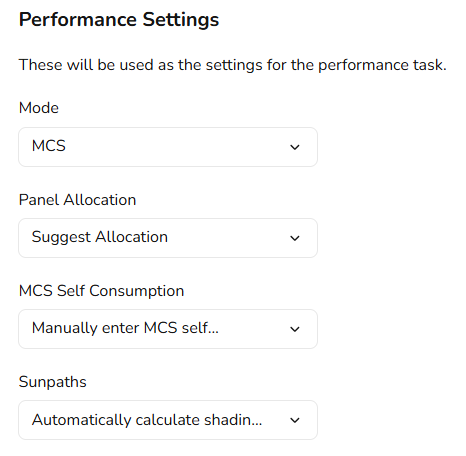
Configure Performance task preferences
You can now set preferences on your account for how you want the Performance task to work.
Mode: Choose between MCS and NREL methods to calculate the total annual generation
Panel allocation: Set whether you want Easy PV to:
- automatically allocate panels - this will entirely skip this step in the performance task if panels can be allocated automatically (you can return to this if you later want to change the allocation).
- Suggest allocation - this will display the suggested allocation which you can accept or edit.
- Manual allocate panels - this will ignore suggested panel allocation and you will need to allocate panels manually.
MCS Self Consumption: Choose whether you want to:
- use default values for MCS self consumption - this will let you set default values which will be used by default for each of the inputs required for the MCS consumption calculations.
- manually enter MCS self consumption - if you select this option you will need to set the inputs required for the MCS calculations on every project.
Sunpaths: Choose whether you want Easy PV to automatically calculate shading based on the terrain and 3D buildings or whether you want this to be excluded so you can set the shading manually.
Set default roof margins
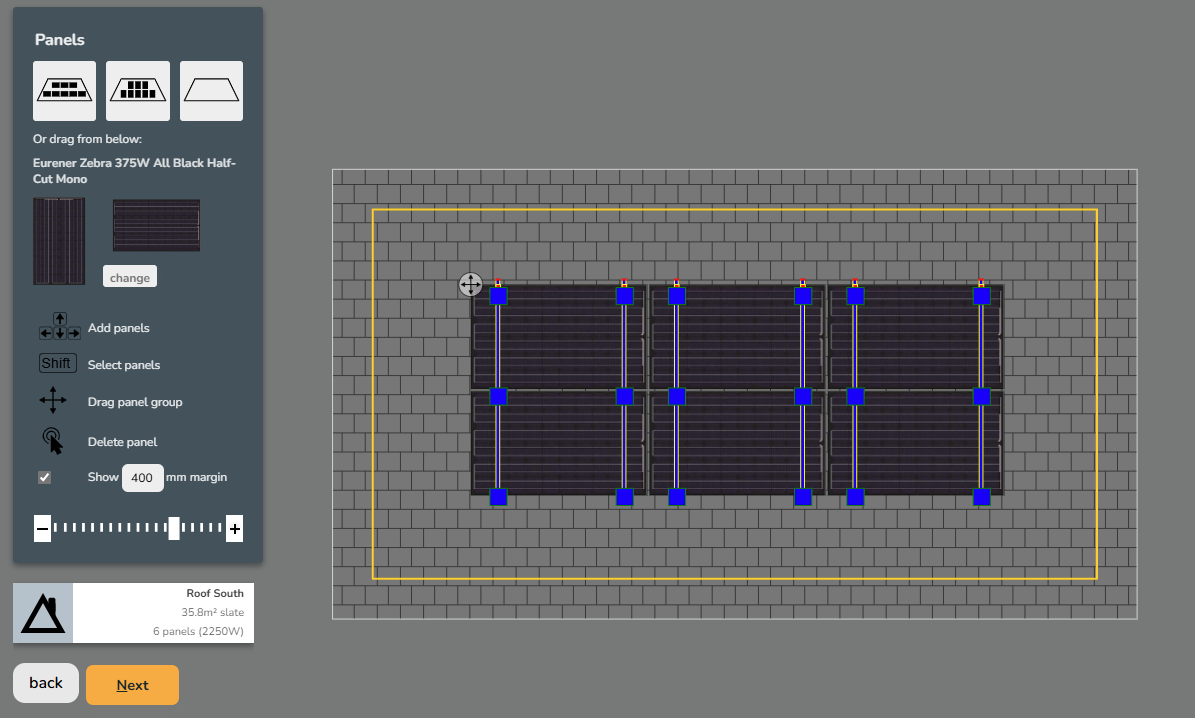
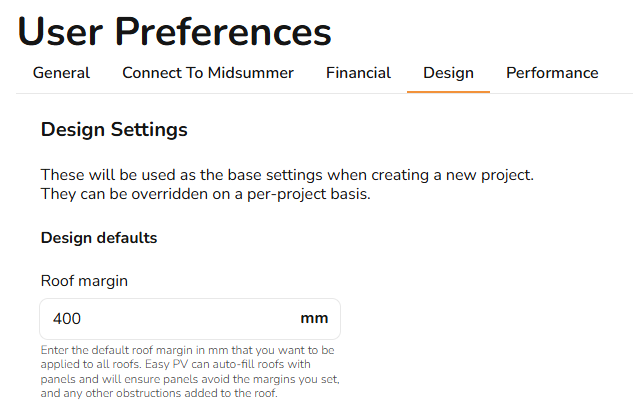
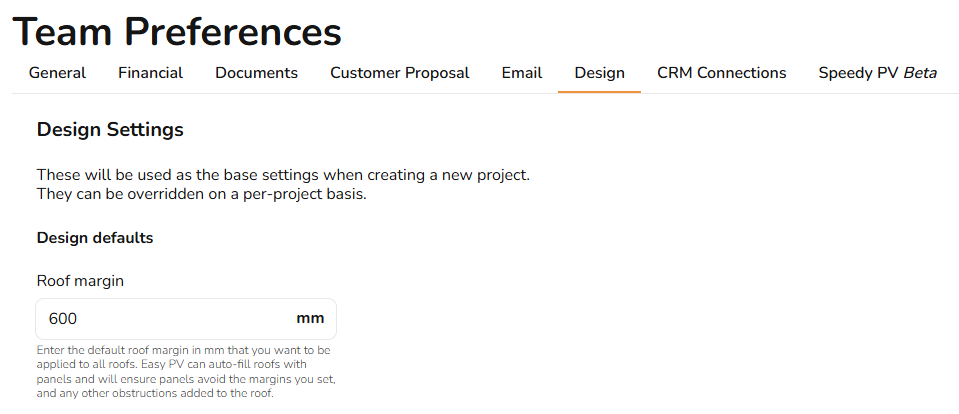
You can now set a default roof margin to apply to all your projects. This is a margin around the edges of a roof that panel arrays should not overlap. It is shown as a yellow line on the roofs in the Easy PV Panels Task. If you use the auto-fill functionality to add panels automatically to the roof, it will ensure no panels cover the roof margin.
For standard (free) Easy PV accounts
For PRO Easy PV accounts
New in September 2024
Lots of exciting new features have been rolled out this month.
New financial task and automatic pricing
We've completely overhauled the financial task to make it quicker than ever to create accurate quotes and projections for your projects. This is quite a big change so take a look at our detailed guide to learn how to use the financial task.
Here's a summary of the important changes:
- You can now manage default financial settings you want to use for all your projects via your account preferences or Pro team preferences. Learn more.
- You can also configure pricing rules so Easy PV can automatically generate quotes for you based on your project design. Learn more.
-
The financial task will automatically generate the quotation and projections based on the defaults and pricing rules you've configured. You can override your defaults on a per-project basis via the settings popup on the financial task.
-
You can also add grants and discounts to the quotation and include loans, running costs and other custom savings in the projections.
-
The projections can now be based on variable-rate tariffs when using the Easy PV consumption task to calculate self consumption.
New MAGIC design mode
We're excited to be releasing a beta version of our new Magic design mode. Using 3D data and high resolution imagery, we automatically work out the form of buildings create 3D models for you, as well as identifying obstructions.
Magic mode is an experimental feature, and we won’t detect every building shape perfectly. Please expect to have to do some tweaking of roof shapes or obstructions on more complex roofs. It works better in urban areas where more detailed aerial imagery is available.
We’re working hard on magic mode, and we expect to regularly release improvements over the coming months. While this service is in the beta phase we are offering access for free to both free and pro users. Free users are restricted to three designs per day. We reserve the right to start charging for the service in future.
Customise customer proposal with your branding
We're delighted to be releasing one of our most requested features. Pro users can now apply their branding to the customer proposal document and apply additional customisations. To configure your customer proposal, navigate to the 'Proposal' tab in your Pro account settings.
- Add a custom cover page
- Customise colours to match your brand
- Add an 'About us' section to the contents page
- Configure a branded page footer to appear on all pages of the proposal document with your logo and company information
- Add your terms and conditions
- Add other important information about your services and the scope of work. This can be overwritten on a project-by-project basis.
New in August 2024
Numerous small updates and enhancements have been rolled to the live site. This includes:
- Retirement of an older version of the PV Array Test Report which has been replaced with a new PV Array Test Report that is up-to-date with MCS documentation
- The addition of a new GSE frame allowing for GSE projects with even more panel sizes
- Updates to structural task
- Allowing for structural calculations if the roof is less than 5 m tall or is not an integer
- Adding in of MCS certificate for a roof hook
New in July 2024
Lots of small updates and enhancements have been released. This includes:
- Updates to 3D design mode
- Improved controls for land boundaries in the 3D design studio
- Improvements to snapping guides
- Ability to set the ridge to gutter distance via the elevations view
- Support for displaying a 3D design preview in the customer proposal document - you can manage this via the Customer Proposal task.
- Updates to data used for structural calculations based on BRE Digest 489 (2014 revised)
- Updates to quick roof design mode
- Ability to clone a roof
- Improvements to snapping guides
New in June 2024
We’ve rolled out lots of new features in time to show them off at the Installer Show at the Birmingham NEC.
For standard Easy PV users
-
New consumption task - this has had a full overhaul and is more flexible and accurate than ever.
-
There are now three options to use for consumption calculations
-
Upload half-hourly customer consumption data as a CSV
-
Input user’s annual energy consumption
-
Or estimate based on example property types
-
-
The calculations can now be based on specific energy tariffs for greater accuracy
-
Add custom electricity import tariffs, including split rate tariffs where different rates apply to daytime and night-time.
-
Add custom export tariffs
-
-
-
Configure financial defaults via your account preferences
-
You can configure the defaults you want all projects to use
-
Pre-set the inflation, financial discount and degradation rates and forecast length (i.e. 25 years)
-
Pre-set the default electricity import and export rates for MCS calculations
-
Choose default consumption method for forecasting (MCS-based, Easy PV Consumption Task, or percentage-based)
-
-
Support for Solshare for shared solar projects on blocks of flats.
-
-
Add to any projects with three phase inverters
-
Simply choose the number of connections you want and Easy PV will specify all the kit you need
-
Order quickly with Midsummer Wholesale directly from the project
-
-
-
Various bug fixes and improvements
And for Pro users
-
DNO applications via the ENA Connect Direct system
-
Allows you to submit a pre-installation application very quickly with no need for manually completing and emailing forms to the DNO
-
DNOs approve or reject application within minutes
-
See the status of DNO applications directly from Easy PV
-
-
Set financial defaults for all users in your team
-
You can configure the defaults you want all projects to use for all your users.
-
Pre-set the inflation, financial discount and degradation rates and forecast length (i.e. 25 years)
-
Set default electricity import and export rates for MCS calculations
-
Choose default consumption method for forecasting (MCS-based, Easy PV Consumption Task, or percentage-based)
-
-
Email sending from your email domain within Easy PV
-
You can now configure Easy PV emails to be sent from a generic email address you own, rather than from a noreply@easy-pv.co.uk email.
-
Via your Pro account settings you can input the SMTP details for the email address you want to use
-
All emails sent from Easy PV by any of your users will be sent to your customers from the email address you have configured
-