# The max voltage calculated in the inverter task doesn't match the Voc from the panel datasheet, why is this?
The max voltage factors in both the **open circuit voltage** (Voc) and the **temperature coefficient** (ΔVoc/°C) of the panel. The value on the datasheet is measured at standard test conditions (STC) but the actual Voc of the panels will depend on the ambient temperature. As the temperature decreases, the Voc increases, so it is important to factor this into sizing the inverter.
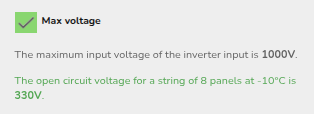
In Easy PV, we do a calculation at -10°C, since the voltage increases at lower temperatures, the max voltage given in Easy PV will be **higher** than the number of panels multiplied by the open circuit voltage of the panels.
Example calculation
[](https://help.easy-pv.co.uk/uploads/images/gallery/2025-10/Y6H6AdxxJxlAN8UU-image.png)
In the above case, the Voc is 37.45V and the temperature coefficient is -0.276%. This means for every increase in °C, the Voc decreases by 0.276%.
For standard test conditions (STC), the panel temperature is 25°C so the change in temperature to -10°C is 35°C, meaning we have
**37.45 \* (1 + (|-0.00276| \* 35)) \* 8 = 328.5 V**
Easy PV does a slightly more conservative calculation:
**37.45 \* (1 - (-0.00276))35 \* 8 = 329.94 V**
where in each case 0.276% is divided by 100 to convert it 0.00276 per °C. This is then rounded to give 330V.