FAQs
Use the search bar in the top left to search our FAQs.
If your question is unanswered here, you can contact us at help@easy-pv.co.uk or help@easy-pv.ie.
- General
- Can I pay Easy PV to design a project for me?
- How do I link my Midsummer Account to pull over my trade prices?
- Can I do a retrofit project in Easy PV?
- Can I do commercial or industrial designs in Easy PV?
- Can I do a battery-only project?
- How do I change my email address?
- Why is my date in the wrong format?
- What's happened to the international site?
- How do I do a hard refresh of my browser?
- Pro
- What additional features do I get with Pro?
- How much does a Pro subscription cost?
- Can I get a free trial of Pro?
- How do I upgrade to Pro?
- My bank is not showing up when trying to upgrade to Pro, what should I do?
- Is there an Easy PV app for the surveys task?
- Can I have a custom cover page?
- Can Easy PV Pro be used as a QMS?
- Does Easy PV have integrations with CRM systems?
- Can I get a refund if I don’t like Pro?
- How do I cancel my Pro subscription?
- What happens to all my cloud stored documents if I cancel my Pro Subscription?
- Can I share projects with other people in my team?
- Can I get my project to share with my team by default?
- Emails and e-signing
- Can I edit the required documents and have them be e-signed?
- Can I change the email templates or add new ones?
- Can I send emails from my email address rather than an Easy PV address?
- Buildings and roofs
- Which design mode should I use?
- Does Magic design mode work in my area?
- Can I upload a CAD file or design PDF to use when doing a design?
- How can I adjust roof measurements in the Roof task?
- Can I change the orientation of the panels on a flat roof?
- The roof type I want isn't an option, what do I choose?
- What is the difference between orthorectified and standard satellite imagery?
- What do I set as the orientation in Quick Roof?
- Panels, inverter and electrical
- How can I model an east-west panel layout?
- The mounting system I want to use isn't an option in the panels task, what can I do?
- I can’t allocate my panels to an inverter - all the options are red.
- The max voltage calculated in the inverter task doesn't match the Voc from the panel datasheet, why is this?
- How is DC cable sizing and voltage drop calculated?
- Can you help me choose kit?
- Custom components
- Can I add components that aren't listed on Easy PV?
- I have added an inverter in 'My Components', but it won't let me allocate any panels. How do I fix this?
- I have selected a custom inverter and it isn't showing the right number of strings. How do I fix this?
- I added a hybrid inverter to ‘My Components’ but can’t add a battery to it in the inverter task.
- I added a battery in ‘My Components’ but it isn’t showing up as an option in the inverter task.
- How do I set up an all-in-one inverter?
- GSE showing as not compatible with my panel but I've checked that is it compatible - why?
- How can I share components with other people in my pro team?
- Performance and consumption task
- Where is section C, D and E of the performance report?
- What is self-consumption?
- The MCS self-consumption calculation doesn't work for my project - why?
- Why has the generation not changed after adding optimisers?
- How does the Consumption task estimate self-consumption?
- What are the differences between the MCS and Easy PV self-consumption calculations?
- Structural and schematic tasks
- Why won't the structural calculations work for my project?
- Why are the weight loading calculations failing for my plain tile roof?
- Why has my schematic not updated after I changed some components in the project?
- Financial task
- How is the payback period calculated?
- The payback period is too long, how can I fix this?
- Why are there two consumption figures to choose from in the financial task?
- How can I factor VAT into the cost?
- How do I factor in a standing charge?
- Why do some of the financial savings appear to be different on the Customer Proposal and Easy PV Project Report?
- Customer proposal
- Why does the quote page still show components I've removed from a project?
- Why are the incorrect tariffs being used in the proposal?
- How can I remove VAT from the cost on the proposal?
- My customer proposoal isn't loading - why?
- Why is the battery page showing as incomplete but I have a battery in the project?
- Why is the payback period on my Easy PV project different from an identical design produced on a different software?
- How do I attach my logo/branding to the customer proposal or Easy PV project report?
- The 3D image on the proposal has not updated after I made changes, how do I fix this?
- How do I hide/show line prices on the customer proposal quote page?
- Where do the numbers on the Financial Benefits page come from?
General
Can I pay Easy PV to design a project for me?
No, this is not a service we offer at Easy PV. If you’re struggling to use the software, you can always come to one or more of our free training sessions!
If you're uncertain on what kit to use, have a chat with your Midsummer account handler and they will be able to assist. You can sign up to a Midsummer account here.
If you're having trouble with a 3D design, we recommend booking onto our 3D training session where we can run through any complex designs with you.
How do I link my Midsummer Account to pull over my trade prices?
To link your Midsummer wholesale account, please follow this guide.
If you do not yet have a Midsummer wholesale account, you can sign up here.
Can I do a retrofit project in Easy PV?
Yes, to create a quote for a retrofit project:
- Recreate the existing system in Easy PV with the new additions.
- Remove all existing components or set their price to £0 in the Financial task.
If you need to create custom components to recreate the existing system, you can use our detailed component guide.
Can I do commercial or industrial designs in Easy PV?
Yes, you can use Easy PV for both commercial and domestic projects. Some features that will help with the accuracy and speed of commercial designs include:
- Automatic panel stringing
- Choice of a range of commercial consumption profiles or upload your customer's meter data directly.
- Support for setting export limits and viewing inverter and export clipping in charts.
More details on these features can be found in our Performance and Consumption task guides.
Can I do a battery-only project?
At the moment, this is not yet a supported feature. However, if you would like to quote a battery only project in the format then you can create a project that has only the quote by following these steps:
- Create a quick roof project
- Skip through the roof task (no need to change anything)
- Open the financial task and fill in the quote
- Generate the proposal
This proposal will contain only the quote.
How do I change my email address?
- Navigate to
My Accountin the top right andMy details. - Under Email type in your new email address.

- Click
Sent verification. - If there is not already an account with that email address, the new email address will receive a link to confirm the change. Click the link to confirm the change.
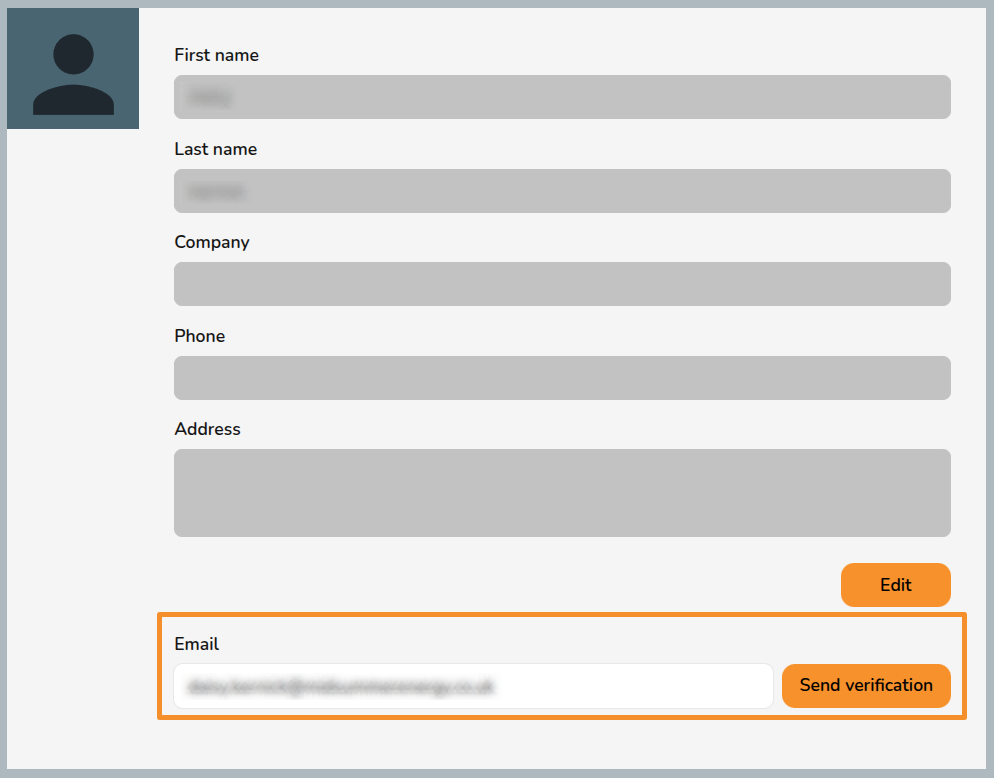
Note: the link will expire after 15 minutes. If you do not click in within that time you will need to generate another verification link.
Why is my date in the wrong format?
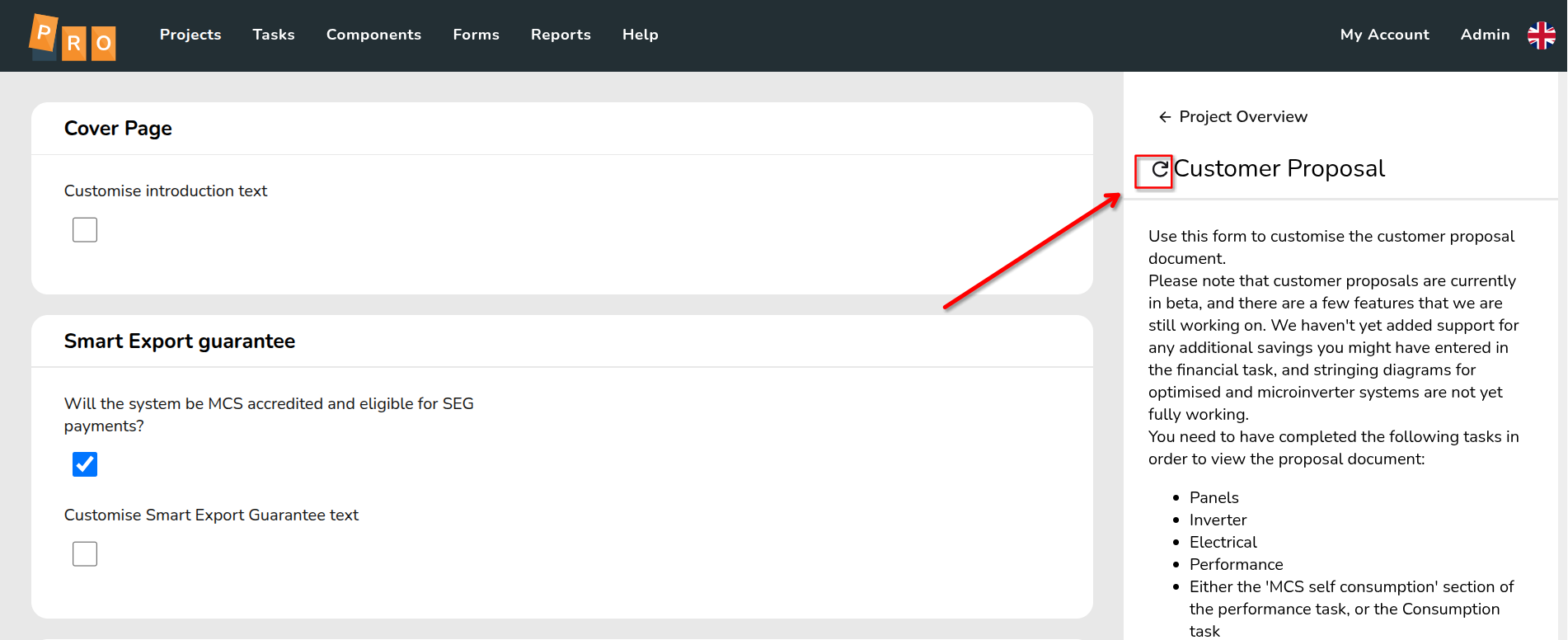
This is set by your device or browser settings, which may be set to English (US), giving the American date format (MM/DD/YYYY). Change this first in your device or browser settings, then reboot your browser (easiest way is to turn your computer off and on again).
Once you have the correct date format, subsequently created projects will display it correctly. You can update existing projects by refreshing the Customer Proposal before generating it:
What's happened to the international site?
As of September 2025, the Easy PV International site (easy-pv.com) will not be available. We’re working on a full upgrade of the International site, and we expect it to be back online within a few months. We’ll notify users as soon as it’s live.
Why is the site not available?
Over the past few years, our UK and Irish versions of Easy PV have seen major upgrades – introducing features like Pro accounts, faster performance, and tools such as automated roof scanning and Speedy PV lead generation. These improvements have made them significantly more powerful and reliable.
Unfortunately, the International site has fallen behind and is built on older infrastructure that’s increasingly difficult to maintain. Rather than patching it, we’ve decided to rebuild it properly so it can offer the same high-quality experience as our other platforms.
As a result of this, the Easy PV International site (easy-pv.com) will no longer be available from September 2025. We’re working on a full upgrade of the International site, and we expect it to be back online within a few months. We’ll notify users as soon as it’s live.
Can I still use Easy PV in the meantime?
You’re welcome to create a free account and use either the UK or Irish sites. Both function reasonably well for international users, although some features may not work (like roof scanning) and some of the calculated generation and consumption data may not be accurate for use outside the UK and Ireland.
I have important project data stored in my Easy PV account, can you help me access this?
Please reach out to our support team and we'll try and help get you access to relevant data and/or documents from your projects.
Need more help?
If you have any other questions or need assistance, feel free to contact us at help@easy-pv.co.uk.
How do I do a hard refresh of my browser?
Sometimes your browser may store old versions of the Easy PV code and this can cause issues. A hard refresh clears your browser cache for a specific page, which forces it to load the most recent version of that page. This could include new scripts, styles or features. Here's how you can clear your cache through a hard refresh on any browser:
Google Chrome
- Load any page on the Easy PV site and make sure you are logged in.
- Windows users: hold down
Ctrland then pressF5on your keyboard (alternatively hold downCtrl+Shiftand pressRon your keyboard). - Mac users: hold down
CmdandShiftand then pressRon your keyboard.
Firefox
- Load any page on the Easy PV site and make sure you are logged in.
- For Windows users: hold down
Ctrland then pressF5on your keyboard. - Mac users: hold down
CmdandShiftand then pressRon your keyboard.
Safari (Mac)
- Load any page on the Easy PV site and make sure you are logged in
- Go to Safari > Empty Cache, or hit
Opt+Cmd+E - To refresh, click the refresh button on the address bar or press
Cmd+R
Microsoft Edge/Internet Explorer (Windows)
- Load any page on the Easy PV site and make sure you are logged in
- Hold down
Ctrland then pressF5on your keyboard (alternatively hold downCtrl+Shiftand pressRon your keyboard).
Important: Clicking the "Refresh" icon on your browser address bar is not a hard refresh.
Pro
What additional features do I get with Pro?
Easy PV Pro has loads of extra features, these include:
-
Group functionality which will allow you to share projects and components and manage your team, and set standard company details for the whole team as well as an automatic price calculator.
-
Organisational and Designing functionality including:
- Unlimited Magic designs,
-
Project sharing and status tracking,
-
Customer proposal customisations,
-
Emailing and doc management,
-
ENA direct connect API for easy, fast DNO applications all within Easy PV,
-
Survey and post-installation tasks,
-
Additional forms a consent waiver, letter of consent form and scaffolding request forms.
- Unlimited Magic designs,
- Access to our lead generation and instant estimate tool Speedy PV.
We are also adding new functionality all the time, including most recently Speedy PV, customer proposal customisations and Magic design mode.
Ready to get started?
You can upgrade your account to Pro directly within Easy PV - just login and look for the 'Upgrade to Pro' link and follow the instructions. If you want to learn more or see a demo of the features book yourself onto one of our FREE online webinars.
How much does a Pro subscription cost?
Easy PV Pro costs £35 (plus VAT) per user, per month. There is no ongoing commitment and you can cancel at any time. If you cancel your subscription it will will remain active until the end of your current subscription period. Please note, we do not offer refunds on Pro subscriptions.
Can I get a free trial of Pro?
If you are interested in a free trial please get in touch at help@easy-pv.co.uk. Please do also book one of our demo webinars to see what Pro can do for you!
How do I upgrade to Pro?
Make sure you're logged into the account you would like to be the Owner of the Pro team. This Owner account cannot be changed or removed from the team. Other members of the team are added during the upgrade process.
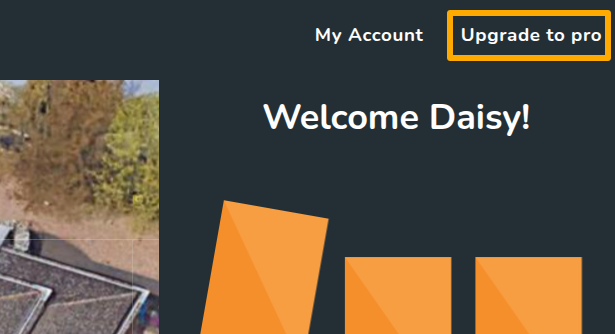
- Click Upgrade to Pro in the top right corner
- Add team members and set their role type
- Connect to Midsummer
- Fill in billing details
- Set up payment
- easy-pv.co.ukPay via GoCardless instant bank payment
- easy-pv.ieSet up Stripe payment
Note: Some banks do not support instant payments so if you're having trouble setting up the payment, please get in touch so we can do this manually.
My bank is not showing up when trying to upgrade to Pro, what should I do?
If you can't find your bank when you enter it's name, try just typing a few letters of the bank name and wait a moment to see what results come up. Sometimes the name of the bank will be slightly different to what you expect it to be. To see a list of all the banks that GoCardless (our payment partner) supports click here.
If you still can't find your bank please get into contact with us at help@easy-pv.co.uk and we’ll get this sorted for you.
Is there an Easy PV app for the surveys task?
The survey task can be completed from any device with a mobile connection, including mobile phones and tablets. Unfortunately, there is no app available for this at the moment.
Can I have a custom cover page?
This is available for Easy PV PRO users. If you are an Easy PV Pro user you can read about how to include a custom cover page and make other customisations to the proposal here.
Can Easy PV Pro be used as a QMS?
No, at the moment Easy PV Pro cannot be used as a QMS. However, we are working towards this functionality with the document management options currently available.
Does Easy PV have integrations with CRM systems?
Yes, here's the list of CRM companies that have integrations or are working on integrations.
-
Helios - live integrations with Easy PV and Heatpunk.
- Payaca - live integrations with Easy PV and Heatpunk
-
Jumptech - in development
-
Zervio - in development
Some of our customers also set up their own custom integrations with their CRM systems using our Open API if they have the technical skills to do so. In some cases customers have used zapier.com services to connect our APIs with their CRM system's APIs.
Easy PV Pro gives you access to generate an API key to use our Open API. Further information about this can be found in our developer guidelines.
Can I get a refund if I don’t like Pro?
If you cancel your subscription it will will remain active until the end of your current subscription period. Please note, we do not offer refunds on Pro subscriptions.
How do I cancel my Pro subscription?
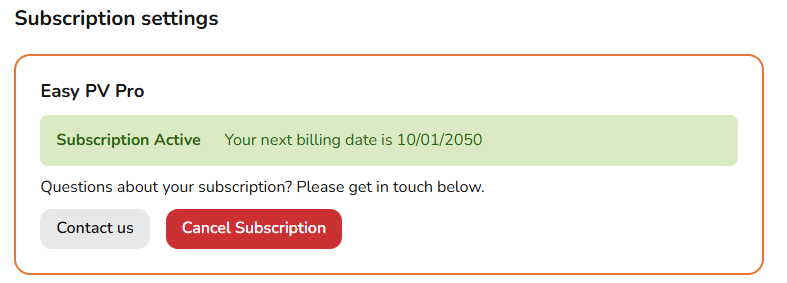
You can cancel your subscription at any point by logging into Easy PV and navigating to Pro Account Settings > General then scrolling to the bottom of the page to view your subscription settings. Only owners and admins of the Pro team can manage the subscription.
If you cancel your subscription it will will remain active until the end of your current subscription period. Please note, we do not offer refunds on Pro subscriptions.
What happens to all my cloud stored documents if I cancel my Pro Subscription?
As per data retention regulations, we will hold your documents according to our data retention policy but they will become unavailable to you. If you wish to keep a record of any documents please do download them and store them as they are generated.
Can I share projects with other people in my team?
Yes, if you have a Pro Easy PV subscription you can share projects with other members of your Pro team.
See this guide for detailed instructions: Share projects and components
Can I get my project to share with my team by default?
Yes, you can set this up in My Account > Preferences by toggling on the sharing permissions you would like to be enabled by default.
See this guide for detailed instructions: Share projects and components
Emails and e-signing
Can I edit the required documents and have them be e-signed?
No, you cannot change the required documents in the document manager or have custom documents e-signed but you can upload as many documents as you wish to individual projects.
Can I change the email templates or add new ones?
The current email templates can only be edited on a case by case basis and new templates cannot be added.
Can I send emails from my email address rather than an Easy PV address?
By default emails sent from Easy PV will send from a “no reply” email address, with your own email address is CC’ed.
You can configure your email settings in Pro account settings > Emails so emails will come from your own domain. Read more about that here.
Buildings and roofs
Which design mode should I use?
Each design mode has benefits depending on the type of project or design you are working on, details on each can be found here.
Does Magic design mode work in my area?
If you notice that Magic scanning isn't working for a customer's property, this is most likely because Google have not performed LIDAR scanning in your area yet. You can check the map on this link to see a rough representation of the areas where this has been done in orange: https://developers.google.com/maps/documentation/solar/coverage.
Magic design mode builds a 3D model of your customer's property, and surrounding buildings for you automatically. It does this by accessing 3D data gathered by Google with LIDAR scanning, stored on their Google Solar API. If you have seen Google Earth recently, you will have noticed this 3D data has also been used to create a 3D map of many cities around the world, as shown in the screenshot below.
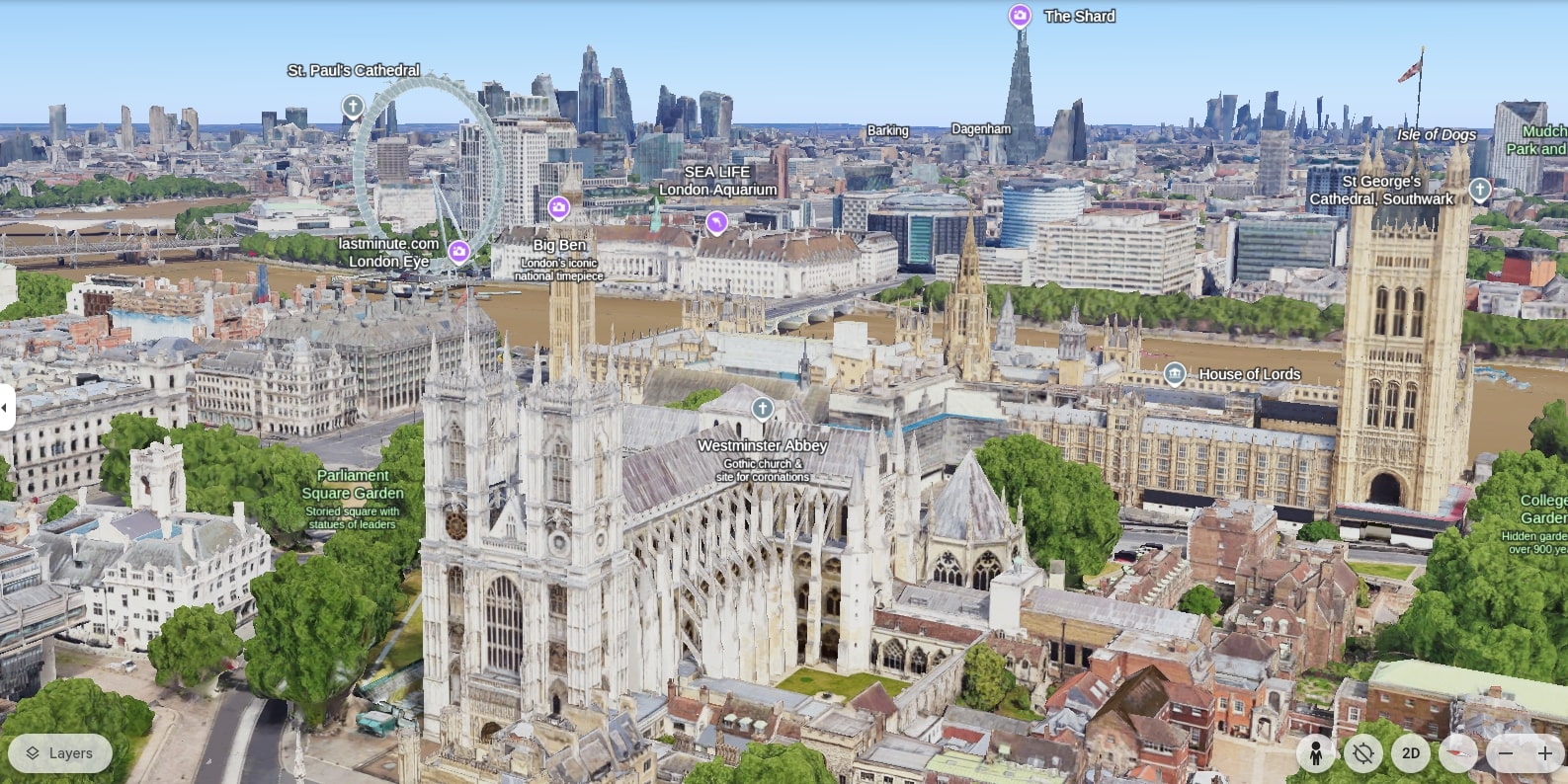
LIDAR scanning is not done by satellites, but rather by aeroplanes, and as such its coverage is much less than the coverage of normal, 2D satellite imagery. Google plans to eventually expand the areas scanned in this way, but so far they have done a pretty good job of scanning the areas where most people live, i.e. urban centres.
Can I upload a CAD file or design PDF to use when doing a design?
At the moment, this is not yet a supported feature. However, our developers are hard at work and constantly adding new features!
How can I adjust roof measurements in the Roof task?
To see the roof dimensions, click on the corner of the roof.
This will show you the dimensions of the two adjoining sides. You can click on either of these figures to enter a new figure. It’s the same process for checking and adjusting the dimensions of chimneys, vents, etc.
Can I change the orientation of the panels on a flat roof?
Yes, you can. Horizontal and portrait panels will automatically be angled toward the “bottom” or “gutter line” of the roof whether flat or ground-mounted. In roof outline mode, the “bottom” of the roof is the first side you draw. In quick roof mode and 3D design mode, the “bottom” of the roof is based on how you set the orientation of the roof.
If you want to change the angle of the panels, you’ll need to change the orientation of the roof. For a standard flat roof, the panels will orient towards the yellow circle:
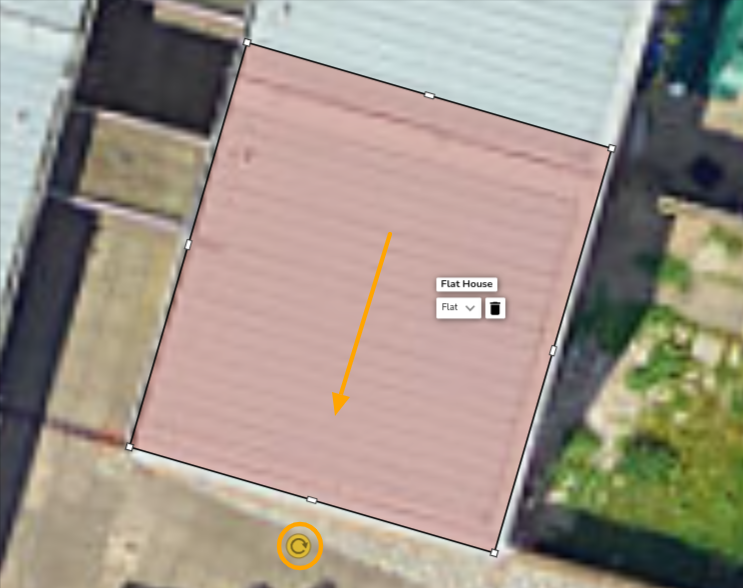
If you want to orient the panels another way on a flat roof you can use the irregular roof tool and the following steps:
Note that this option is only available when using the 3D design mode and will also change the direction of any obstructions on the roof.
- Select the 'Irregular building' option in Misc.

- Set the roof type to flat by clicking on the roof and selecting from the mini-menu

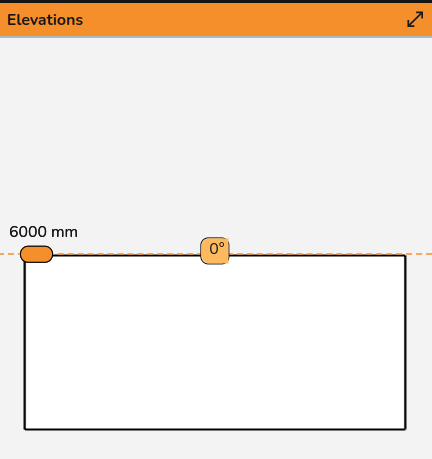
and the pitch to 0 in the elevations view
- Size and reshape the roof to the necessary roof - if needed you can fix the angles of the corners by clicking on the corner and selecting the option highlighted in blue below.

-
Drag the blue dot to direct the arrow, the arrow points in the direction of the panels.

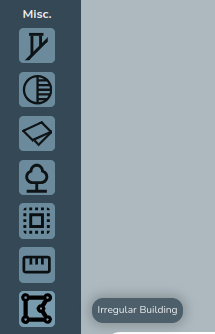
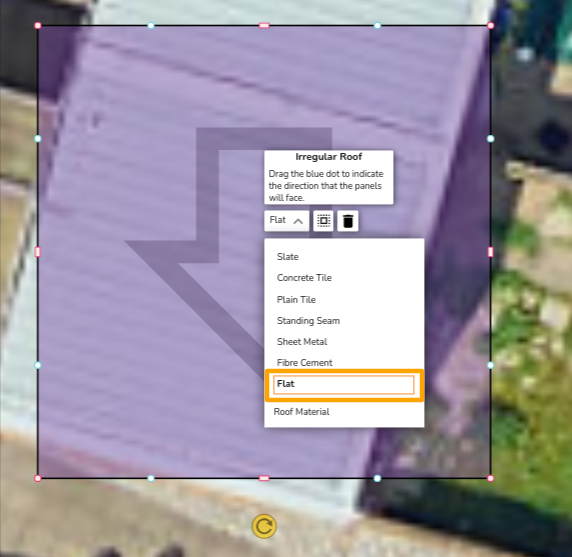
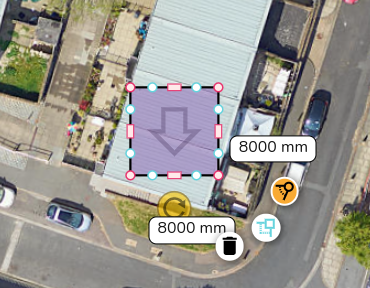
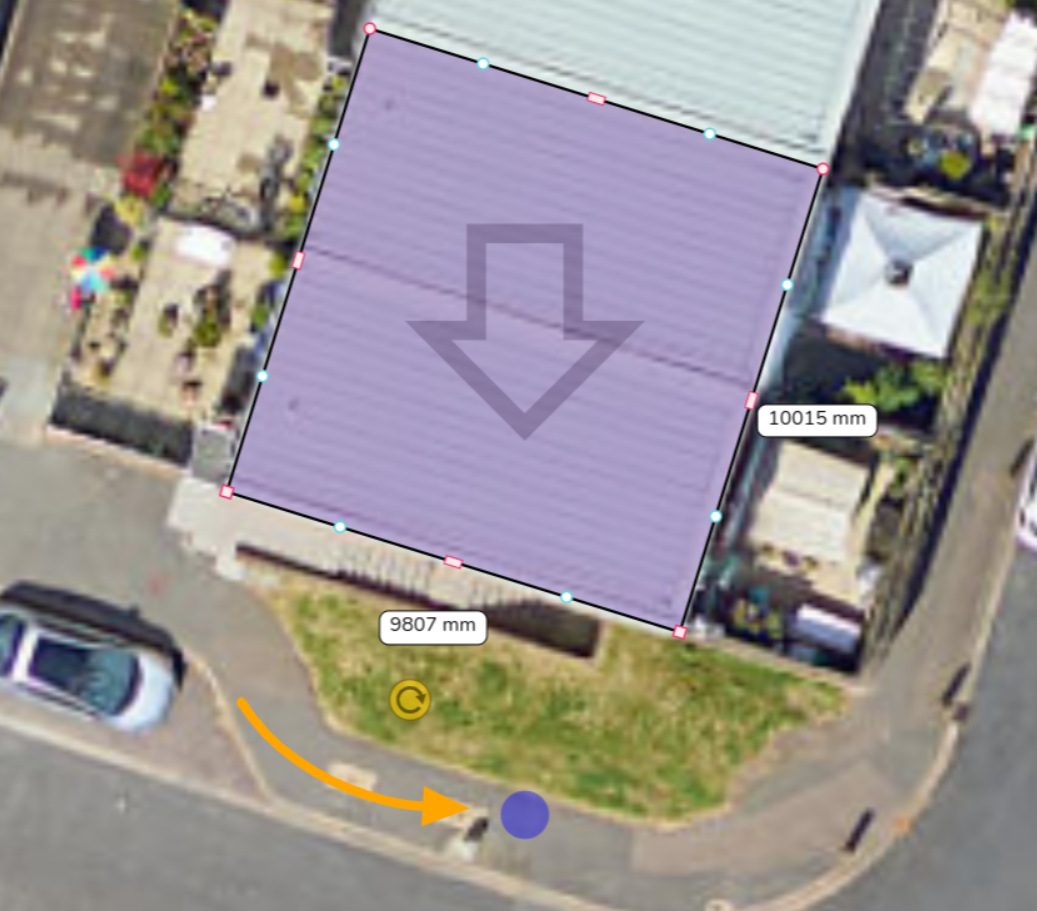
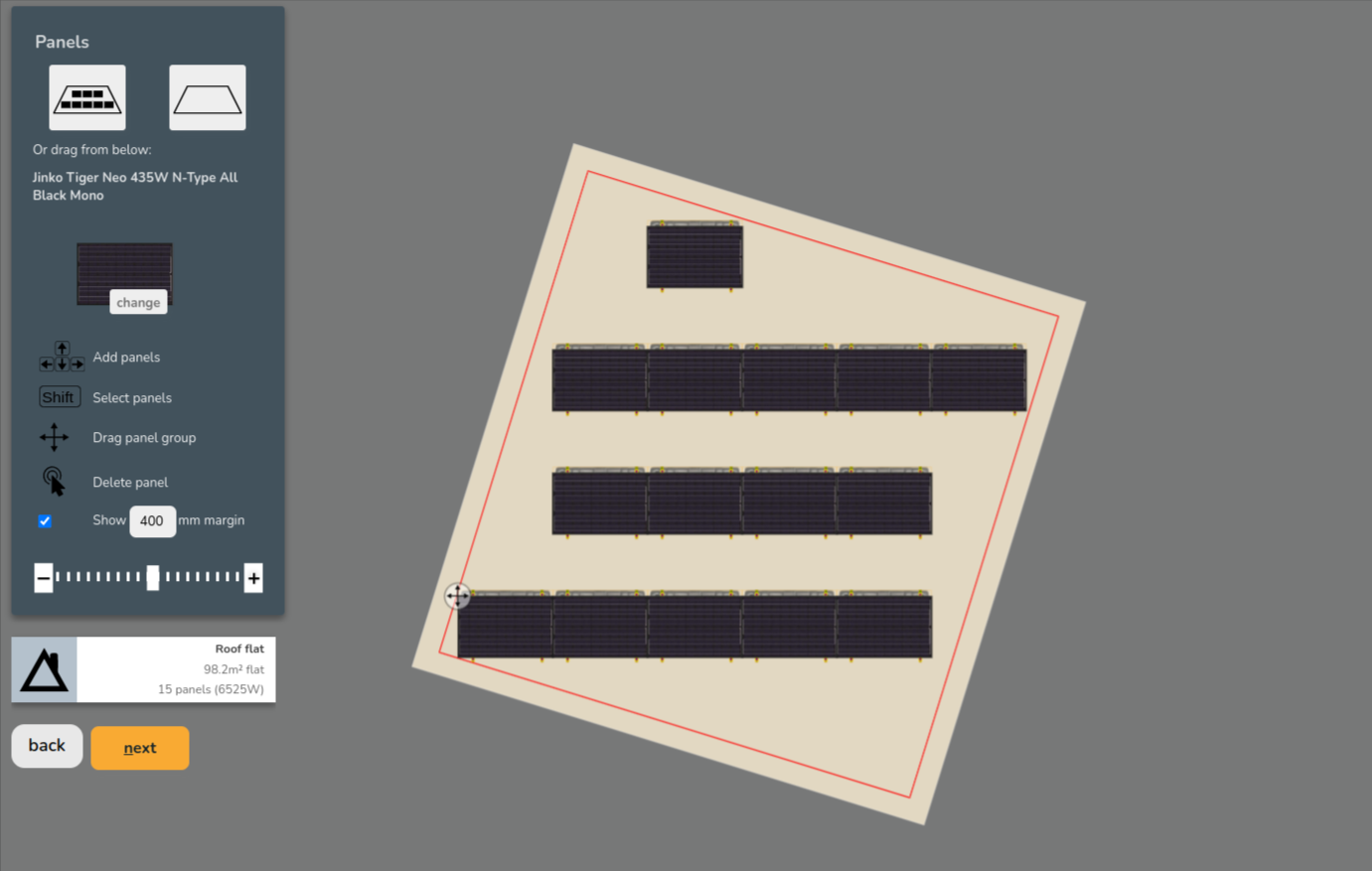
Then when you enter the panels task, the panels will face the direction specified:
The roof type I want isn't an option, what do I choose?
The roof options on Easy PV are slate, concrete tile, plain tile, sheet metal, standing seam, fibre cement, flat and ground mount.
If you need an option that isn't available, the choice you make here will depend on which mounting system you plan on using. You will need to work backwards and select whichever roof covering allows you to select the mounting you want.
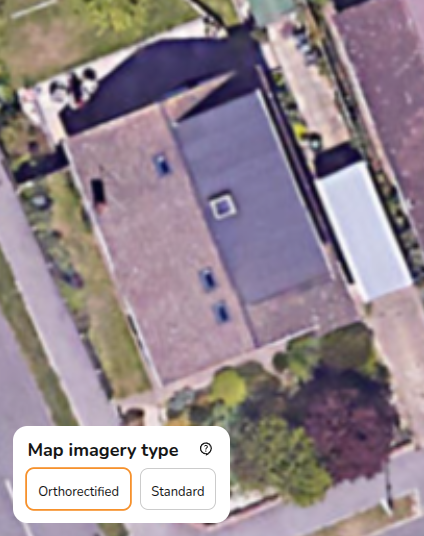
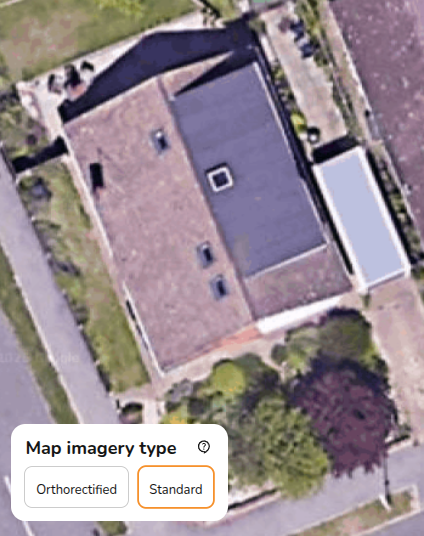
What is the difference between orthorectified and standard satellite imagery?
The orthorectified map is geometrically corrected to give more accurate dimensions. The standard map uses raw satellite data which means dimensions may be distorted, particularly for sloped structures.
Where possible you will want to use the orthorectified map, if it is not available then the dimensions in Easy PV may not be accurate to the actual dimensions.
What do I set as the orientation in Quick Roof?
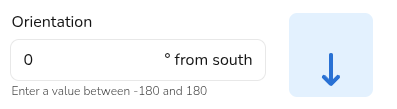
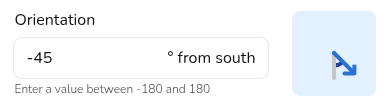
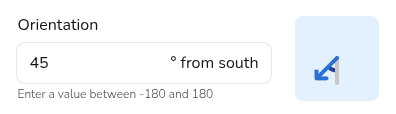
For Quick Roof projects, you have to directly set the orientation rather than it being calculated based on the satellite map. This is done in degrees from south, going clockwise.
For example:
|
|
|
|
|
|
Panels, inverter and electrical
How can I model an east-west panel layout?
To model an east-west panel layout, create a flat roof or ground mount area in any design mode.
In the panels task follow these steps:
- Add panels to the roof/area and then select 'No mounting'
- Set the direction to east-west and configure the spacing as needed

- Select option 1 to fill the roof/area with portrait panels, option 2 to fill the roof with landscape panels and 3 to clear the roof

Or drag and drop portrait (right) or landscape (left) panels to build panel layout
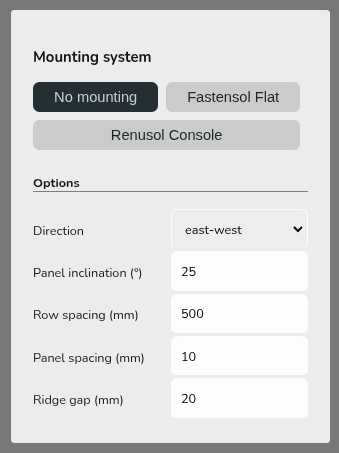
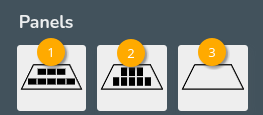
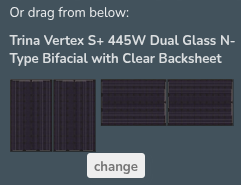
This will not spec the mounting components but will mean the pitch and orientation of the panels is correctly modelled in performance calculations. Get in touch with Midsummer (UK) / (IE) for guidance on mounting components.
The mounting system I want to use isn't an option in the panels task, what can I do?
If the mounting system you'd like to use is not listed in the panels task, select No mounting. Then in the financial task, you can manually input your mounting system so it's still included in the quote.
If the mounting system you want to use is stocked by Midsummer (this includes Van der Valk and K2 flat), you can get in touch with your account handler for help with building the kit list.
I can’t allocate my panels to an inverter - all the options are red.
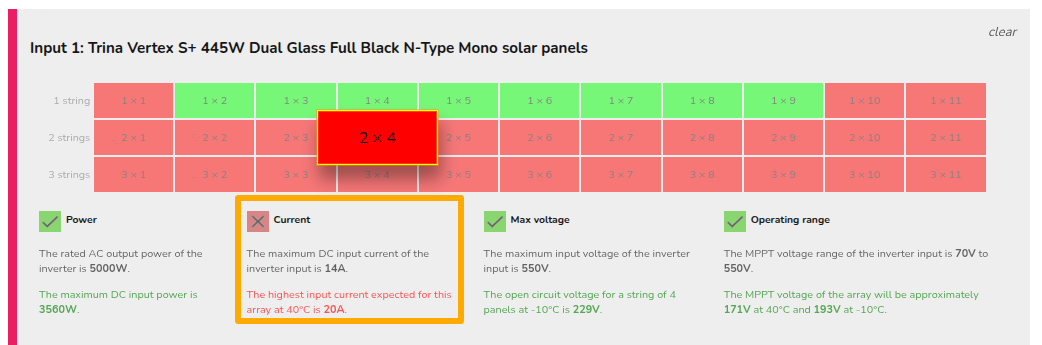
When all of the allocation options are red, Easy PV has determined the panel/inverter combination is not electrically viable. This means that the technical specifications of either the panels or the inverter are out of the range of the other.
When panels have been allocated to an input, Easy PV will outline any electrical issues in red text to make you aware of why it is not compatible. For a custom component this could mean one of the values you have input is incorrect
- Select the option you think should be possible with the inverter and panel
- See which option appears in red

- Check that value against the datasheet, it may be helpful to reference our component upload guide.
The max voltage calculated in the inverter task doesn't match the Voc from the panel datasheet, why is this?
The max voltage factors in both the open circuit voltage (Voc) and the temperature coefficient (ΔVoc/°C) of the panel. The value on the datasheet is measured at standard test conditions (STC) but the actual Voc of the panels will depend on the ambient temperature. As the temperature decreases, the Voc increases, so it is important to factor this into sizing the inverter.
In Easy PV, we do a calculation at -10°C, since the voltage increases at lower temperatures, the max voltage given in Easy PV will be higher than the number of panels multiplied by the open circuit voltage of the panels.
Example calculation
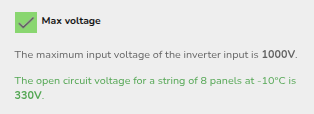
In the above case, the Voc is 37.45V and the temperature coefficient is -0.276%. This means for every increase in °C, the Voc decreases by 0.276%.
For standard test conditions (STC), the panel temperature is 25°C so the change in temperature to -10°C is 35°C, meaning we have
37.45 * (1 + (|-0.00276| * 35)) * 8 = 328.5 V
Easy PV does a slightly more conservative calculation:
37.45 * (1 - (-0.00276))35 * 8 = 329.94 V
where in each case 0.276% is divided by 100 to convert it 0.00276 per °C. This is then rounded to give 330V.
How is DC cable sizing and voltage drop calculated?
Easy PV returns the smallest cable cross-sectional area that achieves a voltage drop less than 1% of the voltage across the cable (or the largest cable if none do).
The voltage drop along a cable is the product of the current and resistance. The current is calculated in the inverter task and we calculate cable resistances from the IEC 60228/BS 6360 stranding chart.
Can you help me choose kit?
The Midsummer team have expertise in kit such as panels, mounting, inverters and batteries. You can get in touch with your account handler or the sales team at trade@midsummerenergy.co.uk.
Custom components
If your problem is not addressed here, it likely will be covered in our detailed custom component guides.
Can I add components that aren't listed on Easy PV?
Yes, for instructions on how to add different components, please read our full component upload guide.
Note, you are not able to add custom optimisers or mounting systems due to the complexity involved in integrating these into the software.
I have added an inverter in 'My Components', but it won't let me allocate any panels. How do I fix this?
If you're inverter looks like this, it means you haven't added any MPPTs.
Navigate back to My Components and open the inverter you have added. Under the Solar section make sure you have added trackers, if you have not added them the Solar section will look like this:
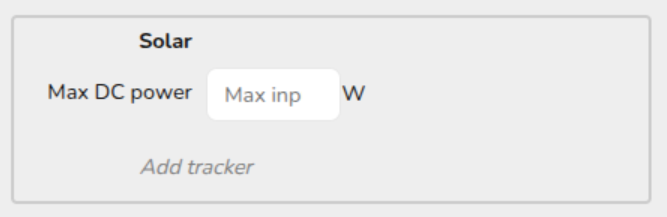
Check on the manufacturer’s datasheet to see how many trackers there are for the inverter.
Click the Add tracker option in the solar section on the right and input the relevant information. Once this is filled in you will be able to allocate the panels to each input.
I have selected a custom inverter and it isn't showing the right number of strings. How do I fix this?
On each inverter, you can see:
- The number of inputs (MPPTs)
- The number of strings on each MPPT
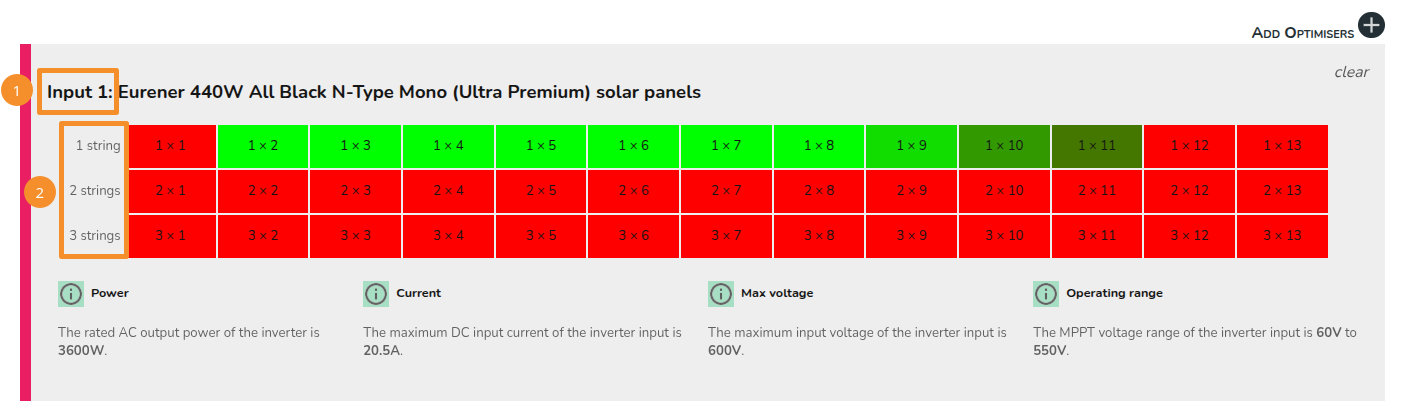
If the number of inputs is incorrect, you need to add more trackers in the Solar section of your custom inverter. The number of inputs will correspond to the number of trackers in this section.
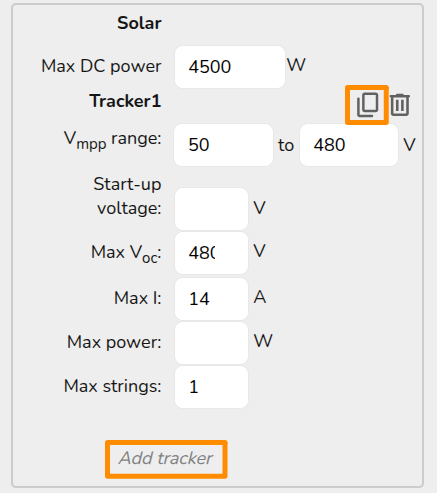
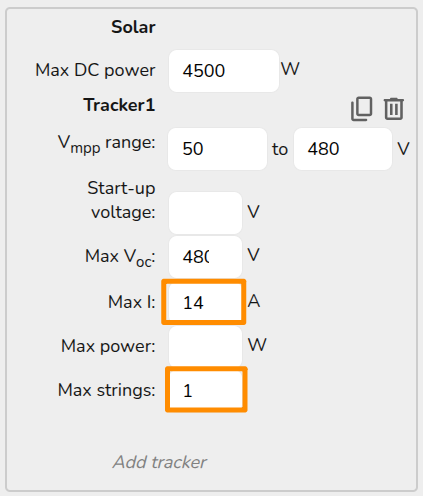
If the number of strings is incorrect, you either need to adjust the number of allowed strings or check the current value in the Solar section of your custom inverter.
I added a hybrid inverter to ‘My Components’ but can’t add a battery to it in the inverter task.
If you are trying to use custom hybrid Inverter and battery components - you will need to make sure you have added the battery as its own component. This is true even for all-in-one systems.
You can do this under Components > Edit Batteries. For more detailed instructions, take a look at our guide to setting up batteries in Easy PV.
I added a battery in ‘My Components’ but it isn’t showing up as an option in the inverter task.
When you add a battery component, you must ensure that you have set the compatibility with your custom inverter category or specific inverter:
- Create battery component
- Under battery rules select 'Selected inverter groups only' or 'Selected specific inverters only'
- Click on the text to show the different inverters and select the check box under your relevant inverter group or inverter

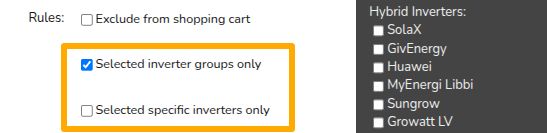
If this does not resolve the issue or now too many the options are showing in red, you will need to look at the max battery capacity value in the Battery section of the hybrid inverter and compare this with the battery capacity of your custom battery.
How do I set up an all-in-one inverter?
To add an all-in-one inverter, follow these steps:
- Set up a custom hybrid inverter
- Set up a custom battery
- Once you have set up the battery, under the battery rules select:

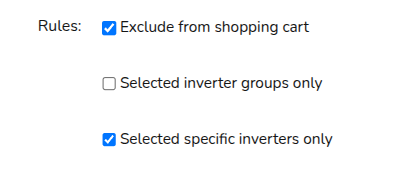
- Selected specific inverter / inverter groups only and select the all-in-one hybrid inverter: this is what tells Easy PV to display the battery as an option when you add the inverter.
- Exclude from shopping cart: This means the battery will not be listed separately on the quote. Note if you select this rule, only the price listed on the hybrid inverter will be factored into the quote, meaning if multiple batteries can be selected the price will need to be changed manually.
GSE showing as not compatible with my panel but I've checked that is it compatible - why?
Open up the details for your custom panel and follow these steps
- Click the text 'Compatible with GSE'
- In the drop down menu select 'half-frame'

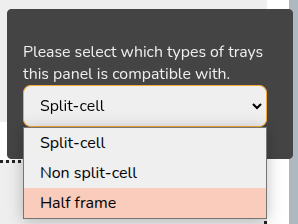
Then the panel will be compatible with the GSE frames we have in Easy PV!
If it still doesn't show as compatible, it likely doesn't fit with the frames we have in Easy PV.
How can I share components with other people in my pro team?
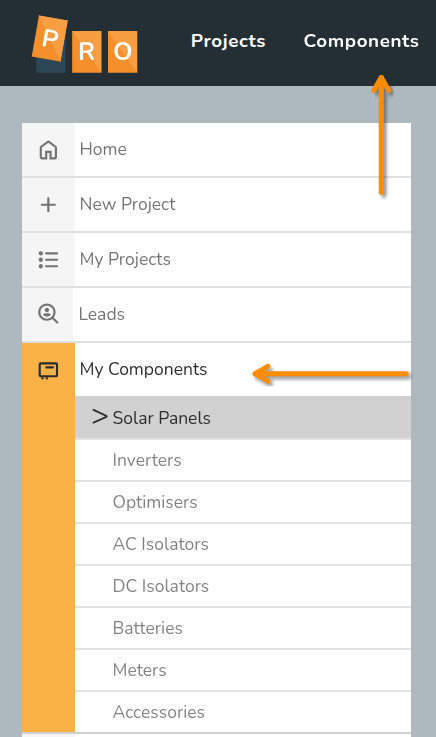
- Navigate to My Components

- Select the component type and component you want to share
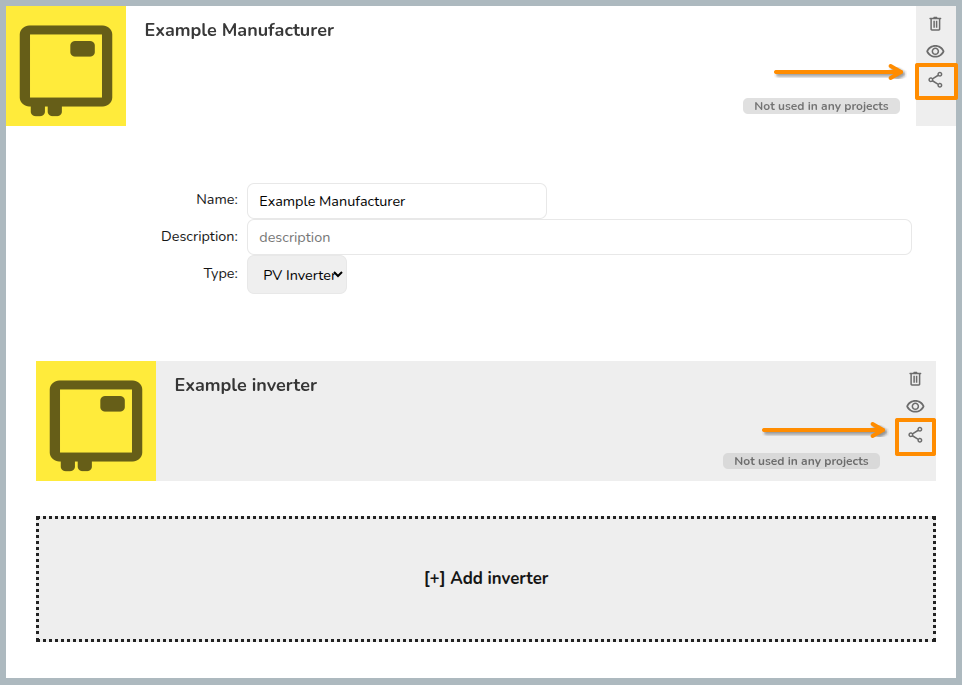
- Click the
 to bring up the sharing permissions menu
 - Select the permissions you'd like to give
- Click
Save

For inverters and solar panels, you will need to make sure you share both the manufacturer group and the individual components.
Read more about sharing projects and components.
Performance and consumption task
A detailed guide on the consumption task can be found here.
Where is section C, D and E of the performance report?
These sections are displayed in both the MCS performance report and the performance and battery pages of the customer proposal. You can find the performance report from the 'forms' drop-down or by clicking the ⋯ three dots in the top corner of the Performance task.
Easy PV will only show these sections in the MCS performance report if the MCS self-consumption calculation has been completed. The MCS method can only be completed if the generation is less than 6000kWh, the consumption is between 1500-6000kWh and the usable battery capacity is less than 15.1kWh. An alternative method is offered in the Consumption task.
As long as the Easy PV or MCS method is selected in the Financial task, the equivalent to section C and D (if there is a battery) can be found in the bottom left corner of the performance and battery storage pages of the Customer Proposal. If there is no battery, sections A-C will appear in the bottom left corner of the performance page.
What is self-consumption?
Self-consumption is the amount of electricity generated that is then consumed within the property. This could be directly or via a battery. As a percentage, the definition is:
Self consumption = Solar PV electricity consumed within property (kWh) / Solar PV electricity generated (kWh)
Energy that is not self-consumed is then exported to the grid. A higher self-consumption typically means a faster payback period since this reduces the amount spent on energy bills. Read here for guidance on how to reduce your payback period.
The MCS self-consumption calculation doesn't work for my project - why?
The MCS calculations won’t work for projects with an annual generation greater than 6000 kWh, annual consumption not between 1500-6000kWh or with battery storage over 15.1kWh.
For these situations, we recommend using the Easy PV Consumption task to generate accurate system projections and then ensure you select the Easy PV calculations in the Financial task.
Why has the generation not changed after adding optimisers?
Adding optimisers in the inverter task will not automatically change the generation. The generation is a product of the kWp of the inverter, the kk value (which itself is based on the pitch, orientation and location of the panels) and the shading factor.
If panels remain grouped the same, their shading factors and kk value will not change. With optimisers, you can put panels in separate shading groups. This allows Easy PV to factor in differences in the kk value and shading factor for the panels in each group on a single string. Without shading groups the generation will not change because the kk value and shading factor will be the same on the whole string, as it would be without optimsers.
How does the Consumption task estimate self-consumption?
Easy PV simulates generation, consumption and battery usage across a full year to estimate how much solar energy is used on site. The self-consumption is the proportion of electricity generated that is consumed on the property (directly or via a battery).
To determine how much is used in the property, we use the total generation figure from the Performance task and model this across the year using a PVGIS generation profile. This is then compared against the chosen consumption profile. Easy PV looks minute-by-minute over the course of the year at how much energy is generated and consumed and, if present, how charged the battery is. It then models how the energy would be diverted accordingly. For example, if solar power is being generated and the profile shows they are consuming energy at that time, then this energy will be diverted to consumption. If they are not consuming at that time then it will be used to charge a battery (where present) or discharged to the grid. This factors in forced charge and discharge times, battery specs and export limits. We can then determine how much is used directly, used to charge the battery or sent to the grid.
What are the differences between the MCS and Easy PV self-consumption calculations?
There are a few differences between the Easy PV and MCS self-consumption calculations:
| easy-pv.co.uk MCS | Easy PV | |
| Easy PV task |
Completed at the end of Performance task, select |
Completed in Consumption task, select |
| System size and consumption |
Strict limits:
|
No limits on system size or consumption. Any consumption, generation or battery capacity |
| Consumption profile | Domestic profiles only: home all day, home half the day and out all day |
Domestic or commercial consumption profiles. Plus the option to upload half-hourly data from customer |
| Method | Determines self-consumption based on look-up tables specified in MGD 003, using annual generation and consumption totals | Models how generation is distributed using PVGIS data, then calculates usage minute-by-minute across the entire year. |
| Additional options | Limited since it only compares annual figures and cannot factor in real-time changes. | Minute-by-minute calculation means export limits, inverter clipping, variable tariffs and forced charging/discharging of batteries are factored into calculations |
Structural and schematic tasks
Why won't the structural calculations work for my project?
Not all combinations of roof material types and mounting systems have structural calculations in Easy PV since the calculations are based on information provided by MCS in MIS 3002.
If you are unable to complete structural calculations in Easy PV you will need to consult a structural engineer.
Why are the weight loading calculations failing for my plain tile roof?
Weight loading calculations will often fail for plain tile roofs. This is because we use MCS default values for the tile density, and the value for plain tiles is much higher than other roof coverings. If you are finding your calculations are failing when you don't expect them to, you can get a tile from the exact roof and measure the kg/m2 to replace this value:
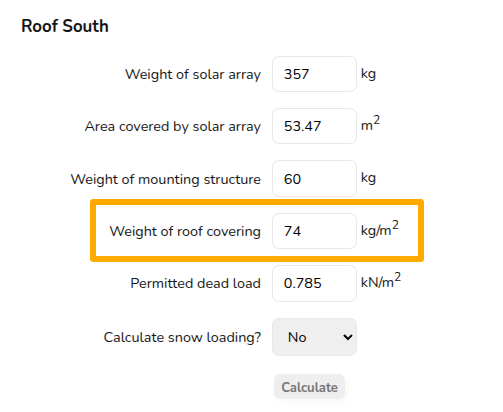
If the calculations are still failing, you will then need to consult a structural engineer.
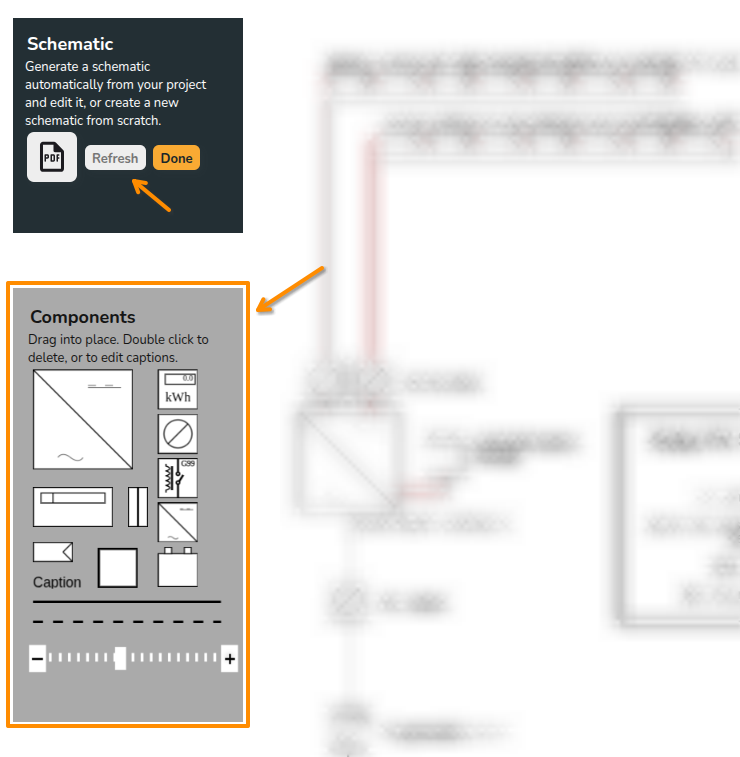
Why has my schematic not updated after I changed some components in the project?
The Schematic does not automatically refresh after changes are made to the project.
If you've changed a component and you want this reflected in the schematic, you can either edit it manually using the components on the side or click Refresh to rebuild the schematic from the project components.
Financial task
How is the payback period calculated?
The payback period is the time it takes for the benefits of the system to outweigh the costs.
Easy PV calculates how much is saved on the electricity bill and earned from exporting across the payback period, using the selected tariffs and factoring in any financial projection settings. It then similarly calculates any costs incurred across the payback period including the upfront cost, finance payments and any maintenance costs.
Take a look at our guide on using the financial task and understanding the financial projection for additional information.
The payback period is too long, how can I fix this?
There are a few things that can help with the payback period. The payback period is calculated by weighing up the cumulative benefits of the system against the cumulative costs. Therefore, to improve the payback period, you either need to reduce costs or increase the benefits,
In general, how to improve the payback period is very case dependent but below are some generic suggestions and key areas to check:
Further information on tariffs can be found in our tariffs guide.
Why are there two consumption figures to choose from in the financial task?
If you have completed both the MCS self-consumption calculation and the Easy PV consumption calculation in the project, both figures will appear as options when you open the Financial task in Easy PV.
The MCS method is calculated end of the Performance task for easy-pv.co.uk and the Easy PV method is calculated in the Consumption task. Both are acceptable methods for calculating the self-consumption, you are free to choose either calculation. You can read more about the differences here.
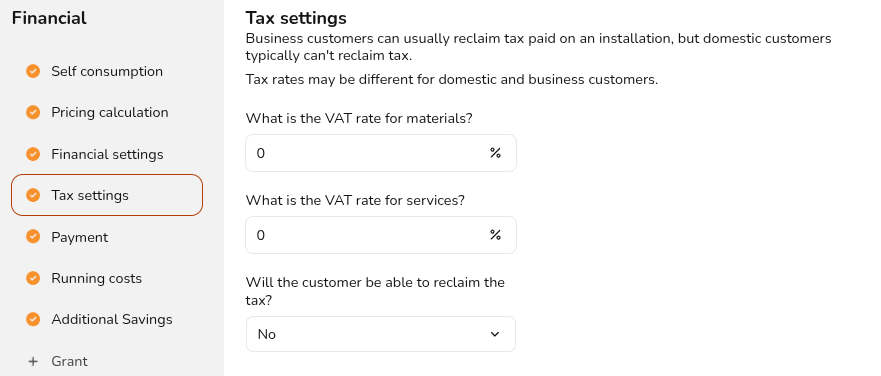
How can I factor VAT into the cost?
Yes, you can do so by following these steps:
- Navigate to the Financial task
- Click the pen in the top right corner
- Then under Tax settings you can set a rate for materials and services, and include whether the customer can claim this tax back

How do I factor in a standing charge?
Easy PV does consider standing charges in it's financial calculations so it is unfortunately not possible to factor in.
Why do some of the financial savings appear to be different on the Customer Proposal and Easy PV Project Report?
Easy PV uses two different methods of calculating financial savings.
1) We do a basic calculation to work out a headline year one/first year saving figure that can be used on proposal summaries, etc. This calculation doesn’t take into account inflation or degradation rate.
2) We calculate a financial forecast showing payback for a longer period (25 years by default). This takes into account inflation, degradation, and discount rates. In the first year, we apply half the % values for each of these rates rather than the full % value. If you're wondering why we use half the % values for the first year, please see below for an explanation.
Further information
When you pay for a PV install you do so in a lump sum on day 0. You then start getting savings and export income from it. But by the end of the first year, monetary values have risen by inflation. So if you were saving £100 / month for electricity on day 0, by the end of the year - day 365 - you are saving £104 / month if the inflation rate is 4%.
When working out the savings for year 1 therefore, we need to work out the average for the year. If savings were £100/month at the beginning, and £104/month at the end the average is £102/month. So for that first year, we use half the inflation value to work out the average savings.
For year two, we again need to use the average value of money over the course of the year. This will have increased by the value of inflation from the value that we used for year one. Basically we are comparing the value of money at 6 months to the value at 18 months. So £102 for year one becomes £106.08 (£102 * 1.04) if the inflation rate is 4%.
It's exactly the same with degradation. On day zero the panels are generating at 100%. By day 365 they have degraded slightly. With degradation of 1% a year we would expect them to be at 99% capacity. The expected average generation for the year is halfway between those two values, so we use 99.5% for year one rather than 99%.
Customer proposal
Why does the quote page still show components I've removed from a project?
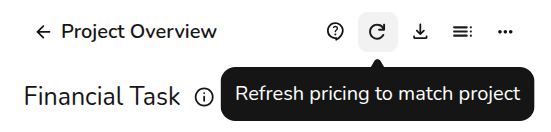
If you changed the component after initially opening the financial task, you will need to refresh the kit list.
- Open the financial task
- Click the
 icon in the top right
 - Click Recalculate cost of goods.

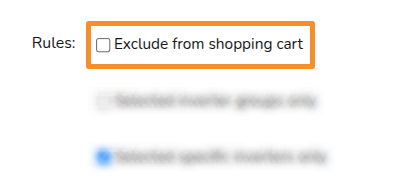
If the component is a battery and it's still not showing up, make sure you haven't selected the Exclude from shopping cart rule on the battery:
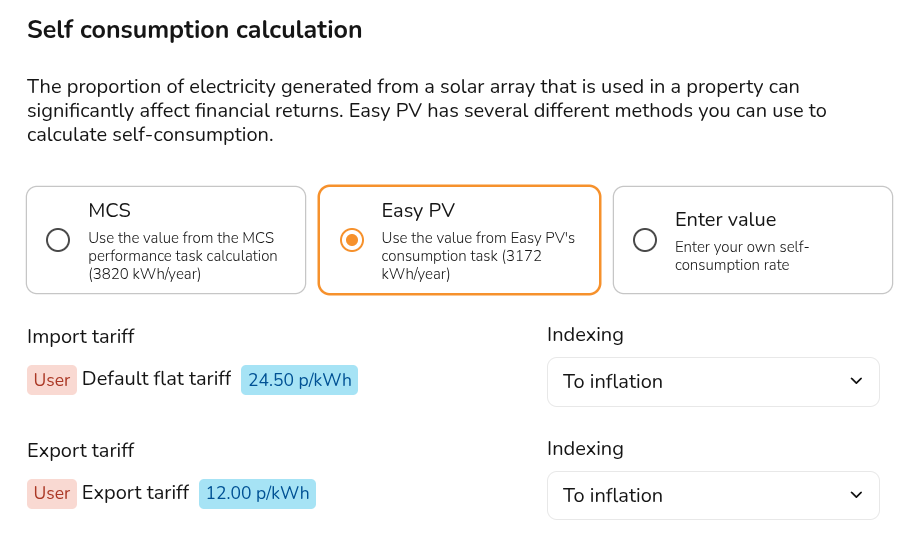
Why are the incorrect tariffs being used in the proposal?
If the tariffs in the proposal do not match the ones you've set up, it's likely you're using the wrong self-consumption method, as these use separate tariffs.
To fix this, follow these steps:
- Navigate to the Financial task
- Select Financial inputs in the top right
- Under self-consumption, you can see the method selected and which tariffs are being used. Make sure you have both the right tariffs and method selected there:

- Save and exit
How can I remove VAT from the cost on the proposal?
You can do so by following these steps:
- Navigate to the Financial task
- Click the pen in the top right corner
- Then under Tax settings select 'Yes' under 'Will the customer be able to reclaim the tax?'

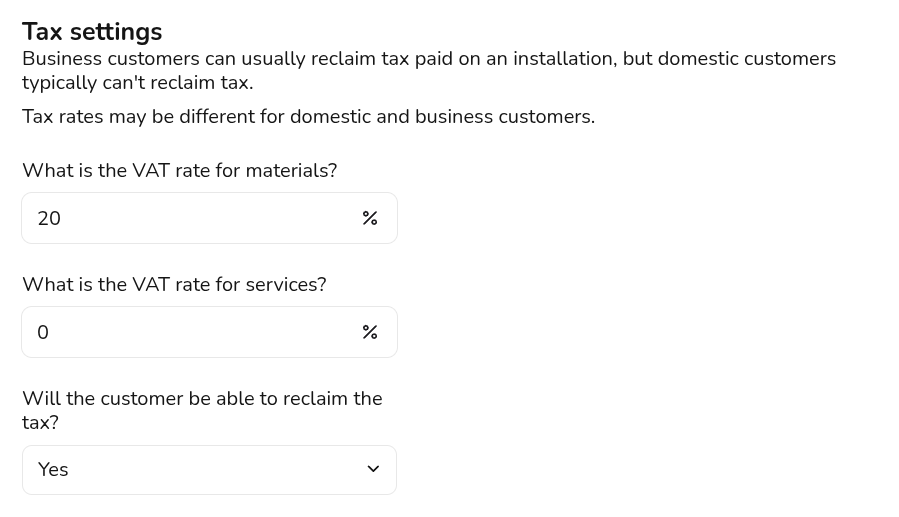
The cover page cost will then display excl. VAT. The quote total will still display inclusive of VAT.
My customer proposoal isn't loading - why?
If your report isn't loading, it's likely because Easy PV is missing some information it needs to generate it.
Usually blank proposal are caused by issues with the Performance task. Navigate to the task and make sure each step has been completed. If you go to the performance task and there are no errors, then we suggested contacting us on help@easy-pv.co.uk.
Why is the battery page showing as incomplete but I have a battery in the project?
This page can only generate with the Easy PV or MCS self-consumption method selected in the Financial task.
To fix this, follow these steps:
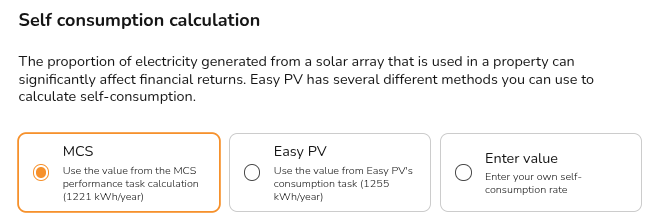
This is because Easy PV needs to model how much of the consumption is coming from solar directly, from the battery or from the grid in order to generate that page. When you select 'Enter value', you are giving a flat self-consumption rate that includes all solar self-consumption, regardless of whether it's used to charge the battery before it's consumed directly.
Why is the payback period on my Easy PV project different from an identical design produced on a different software?
There is a variety of reasons the payback period could have come out differently. Even with identical kit and system cost, many different assumptions made throughout a design can lead to significant differences in the payback period.
The first things to check are:
- Performance task: Is the generation figure the same? If not, are the proposals using the same shading factors?
- Consumption/Financial task: Is the total consumption the same? Are the tariffs the same? Is the self-consumption calculation method the same?
- Financial task: Is the inflation, degradation and discount rate the same?
The most common reason for significant differences in payback time is that most other software calculates a standard payback period, whereas we use a discounted payback period. In short, a discount rate helps reflect the fact that £100 now is worth more than £100 earned in 10 years. Translating future earnings into terms of today's money has a negative impact on the total income and savings values and leads to a higher, but more accurate figure. The discount rate can be adjusted down to 0 in the financial settings of a project to make Easy PV also calculate a standard payback period.
Learn more: Consumption task, Financial task, Performance task.
How do I attach my logo/branding to the customer proposal or Easy PV project report?
To attach your Logo to the Easy PV Project Report navigate to My Account in the top right of the Easy PV home page and then Preferences. Once in this menu, scroll down to the Company Logo section and click on the current logo image. You can then upload your logo.
Please note that the logo will only appear on the quote page of the customer proposal report. Further customisation of the customer proposal is available with Easy PV Pro, get in touch with us at help@easy-pv.co.uk if you're interested in a free trial!
The 3D image on the proposal has not updated after I made changes, how do I fix this?
The overview image must be updated when changes are made to the design. To do this, navigate to the Customer proposal form (before clicking generate pdf) and scroll down to the Overview page section:
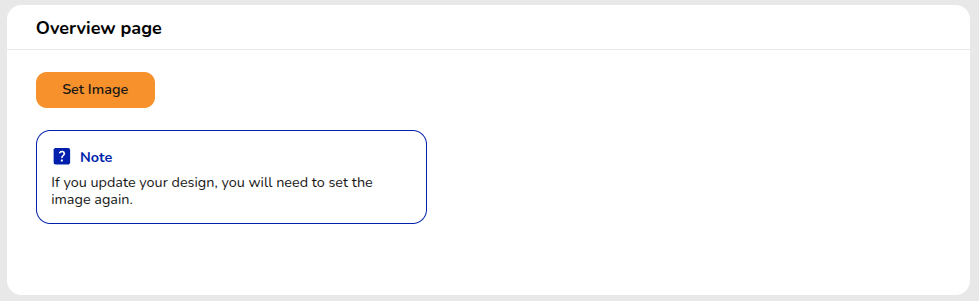
Select Set Image and then Save.
How do I hide/show line prices on the customer proposal quote page?
Select Customer Proposal from the Tasks drop-down menu.
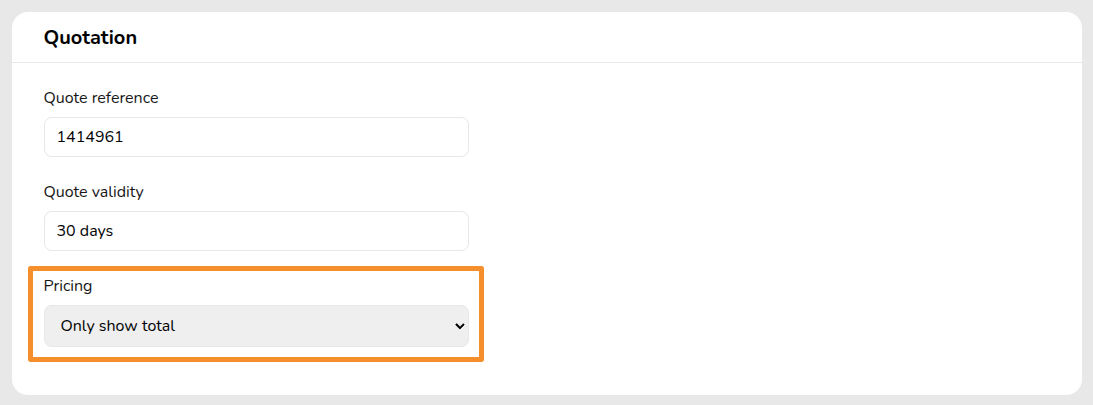
In the section titled Quotation you can change the pricing to:
- Show line items,
- Show equipment and services subtotals,
- Only show total.
Where do the numbers on the Financial Benefits page come from?
The Financial Benefits calculated based on the tariffs that you input. You can take a look at how to create and manage your tariffs here.
Here is a breakdown of the figures on the graph given on the Financial Benefits page of the Customer Proposal.
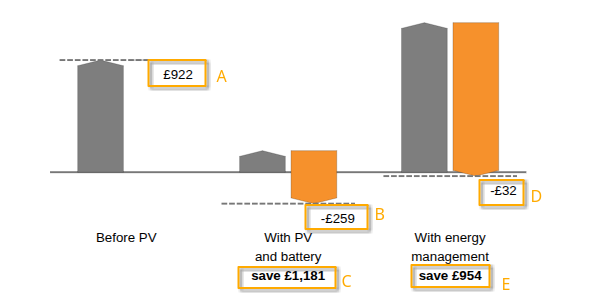
A - The total cost per year before the PV system.
B - The cost after PV and battery including savings from exporting (In this case, a negative number because they will actually be making a profit).
C - The difference between the original cost before PV & battery and after.
D - The export profit with energy management (overnight charging).
E - The difference between how much you pay for energy before solar and what you 'pay' after energy management.